Mould on your ceiling after rain means moisture has reached the plaster, and it will not stop on its own.
That discoloured patch spreading across your ceiling after heavy rain is more than cosmetic. By the time mould is visible on the surface, the colony has already worked its way into the plaster or timber beneath.
This article explains why mould appears on ceilings after rain, what is happening inside the ceiling cavity, and why surface cleaning only buys you a few weeks before regrowth.
Already dealing with ceiling mould? Start with a free mould inspection to find out how far the problem has spread, or read more about professional mould removal.
Why Mould Appears on Your Ceiling After Rain
Rain introduces moisture into your ceiling in two ways. A roof leak lets water soak directly into plasterboard and timber framing, while the humidity spike after heavy rain creates condensation where warm indoor air meets the cooler ceiling surface.
Mould spores are already present in every home, sitting dormant on surfaces until three conditions line up:
- Moisture from a leak, condensation, or high indoor humidity
- An organic food source like plasterboard paper, timber framing, or household dust
- Still air with poor ventilation that lets dampness sit undisturbed
Once those conditions are met, a visible mould colony can establish within 24 to 48 hours. The root structure, called hyphae, penetrates into the substrate even faster.
Wiping mould off the surface after rain does nothing to stop it returning. The hyphae remain embedded in the ceiling material, and the next rain event triggers regrowth within weeks.
According to NSW Health, mould begins growing within 24 to 48 hours of water exposure and poses respiratory health risks if left untreated. Research from The Conversation confirms these outbreaks are increasingly common after heavy rain events across eastern Australia.
Roof Leak or Condensation? How to Tell the Difference
Not all cases of mould on your ceiling come from a leaking roof. Sometimes the cause is condensation from indoor humidity that exceeds safe levels, and the fix is completely different.
| Sign | Roof Leak | Condensation |
|---|---|---|
| When it appears | During or immediately after rain | Cold mornings or humid weather |
| Pattern | Concentrated around one spot with a water stain | Spread across a wider section of ceiling |
| Location | Near roof penetrations (vents, skylights, antenna mounts) | Bathrooms, laundries, or rooms with poor airflow |
| Ceiling feel | Wet or spongy to touch | Damp or clammy but not soaking |
| Insulation | Water-damaged in one spot above | Missing or compressed across the area |
Regardless of the cause, surface cleaning with bleach or vinegar does not reach the mould root structure. A professional mould inspection identifies hidden mould behind walls and within the ceiling cavity and maps the extent of the colony beneath the surface.
What to Do in the First 72 Hours
The window between a ceiling getting wet and mould establishing itself is roughly 24 to 48 hours. What you do in the first 72 hours determines whether you are dealing with a damp patch or a full colony.
- Document the damage. Photograph the wet area and the source of the leak for insurance purposes.
- Move furniture and belongings away from the affected area to prevent secondary mould growth.
- Ventilate the room. Open windows for cross-flow, but do not fan the wet ceiling directly as this can spread spores.
- Do not paint or seal over the damp area. Trapping moisture behind paint accelerates hidden growth.
- Call a professional if the wet area is larger than 30 centimetres across or the ceiling feels spongy.
What Is Happening Inside Your Ceiling Cavity
The visible mould on the painted surface is the tip of the problem. Behind the plasterboard, conditions are far worse.
Ceiling cavities trap moisture. Insulation batts absorb water from leaks and hold it against the timber framing for weeks, creating a dark, still, damp environment where mould colonies spread unchecked.
- Timber framing develops structural mould that weakens load-bearing capacity over time
- Insulation batts become waterlogged and lose their thermal rating completely
- Electrical wiring sits in a damp environment that accelerates corrosion
- Mould spores circulate through every room each time the air conditioning or heating runs
Spraying bleach on the visible patch below does nothing to address the growth above. The surface mould returns within weeks because the root structure and the moisture source are both untouched.
Health Risks of Ceiling Mould Left Untreated
Ceiling mould that keeps returning affects more than the look of your home. The spores released into your indoor air can trigger respiratory problems, particularly for people with asthma, allergies, or compromised immune systems.
Common health effects of prolonged mould exposure include:
- Persistent coughing, sneezing, and nasal congestion that clears up when you leave the property
- Worsening asthma symptoms and increased frequency of attacks
- Skin irritation, rashes, and itchy or watering eyes
- Headaches and fatigue with no other obvious cause
Wiping the surface removes what you can see but does not stop spore production from the colony embedded in the substrate. A professional mould testing service can measure airborne spore levels and identify which species are present.
Why DIY Ceiling Mould Removal Fails
Most homeowners across Newcastle and the Central Coast reach for bleach, vinegar, or a mould spray from the supermarket. These products remove the surface discolouration, and for a few days the ceiling looks clean.
- Penetrate the substrate. Retail sprays sit on the painted surface. Mould hyphae extend millimetres into plasterboard and timber.
- Identify the moisture source. Without finding and fixing the leak or condensation issue, the conditions that caused mould remain unchanged.
- Contain spore release. Scrubbing mould without containment sends thousands of spores airborne, starting new colonies elsewhere.
- Treat the ceiling cavity. DIY products only reach what you can see. The mould above the plasterboard is completely unaffected.
Professional mould remediation treats the root structure using an Australian-made, non-hazardous antimicrobial solution that penetrates the substrate. This is what allows Mould and Hygiene Solutions to back every treated area with an unconditional 12-month mould-free guarantee.
How Professional Ceiling Mould Treatment Works
Professional mould treatment follows a process that no retail product can replicate:
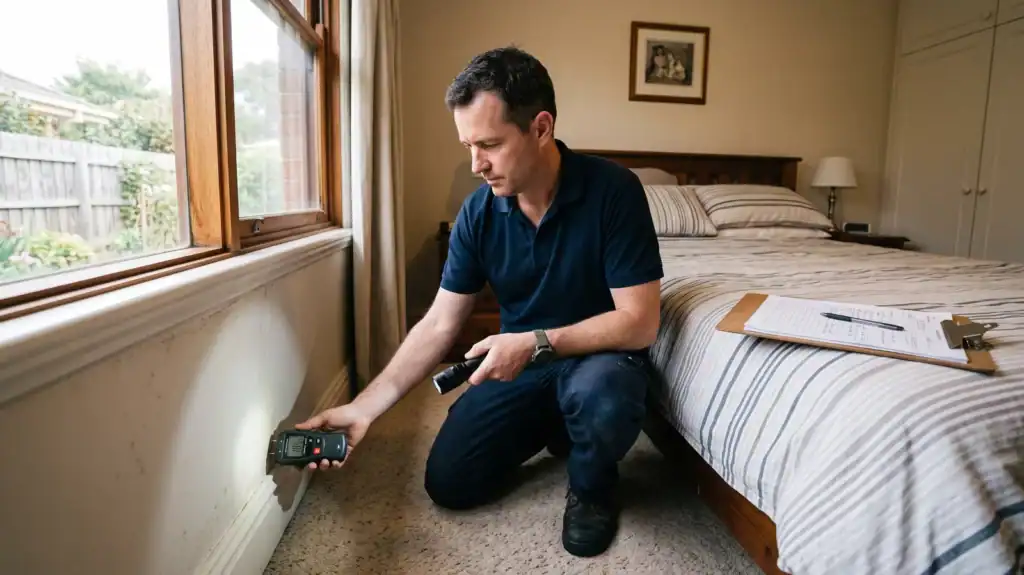
- Inspection and moisture mapping. Moisture meters and thermal imaging identify every affected area, including hidden growth in the ceiling cavity.
- Containment. The work area is sealed to prevent spore spread during treatment.
- Antimicrobial treatment. The solution kills mould at the root level, penetrating plasterboard and timber to reach embedded hyphae.
- Moisture source resolution. The leak or condensation issue driving the problem is identified and a fix is recommended.
- Prevention treatment. A preventative barrier is applied to stop regrowth, backed by the 12-month mould-free guarantee.
James, the owner of Mould and Hygiene Solutions, completes every job personally. There is no subcontractor variation in quality.
Preventing Ceiling Mould After Future Rain
Once existing mould is professionally treated, preventing recurrence means addressing the moisture source.
For Roof Leaks
- Have a roofer inspect flashing around vents, skylights, and antenna mounts
- Check and clear gutters before the wet season starts
- Replace cracked or slipped roof tiles before the next heavy rain
For Condensation
- Install or replace ceiling insulation to meet the minimum R-value recommended by CSIRO for your climate zone
- Add exhaust fans in bathrooms and laundries that vent to outside, not into the roof cavity
- Run a dehumidifier during extended wet periods to keep indoor humidity below 60%
- Open windows for cross-ventilation on dry days to flush out stale, humid air
Mould prevention treatment can also be applied to ceilings that have not yet developed mould but sit in high-risk areas of the home.
Properties throughout the Hunter Valley, Lake Macquarie, and Port Stephens are particularly vulnerable to ceiling mould after rain due to the region’s coastal humidity and older housing stock with limited insulation.
Is Ceiling Mould After Rain Covered by Insurance?
If mould developed as a direct result of storm damage to your roof, the remediation costs may fall under your home and contents policy as part of the storm damage claim.
However, insurers typically reject claims where the mould resulted from a maintenance issue, where there was an unreasonable delay in taking action, or where the cause was condensation rather than a specific weather event.
A professional inspection report documenting the moisture source, extent of the colony, and timeline of damage is the strongest evidence for a claim. Getting a professional inspection within the first few days after a storm strengthens your position with your insurer.
When to Book a Professional Inspection
Book a professional inspection if any of these apply:
- The mould covers more than one square metre of ceiling
- The mould returns within weeks of cleaning
- You can see water stains, bubbling paint, or sagging plasterboard
- There is a musty smell even when you cannot see visible mould
- Anyone in the household has unexplained respiratory symptoms or allergic reactions
- The property has been through a storm or flood event
Mould and Hygiene Solutions offers free inspections across Newcastle, the Central Coast, Lake Macquarie, Hunter Valley and Port Stephens.
Book your free mould inspection today and find out exactly what is happening above the surface.
Frequently Asked Questions
How quickly does mould grow after rain comes through the ceiling?
Mould spores can begin colonising damp plasterboard within 24 to 48 hours of moisture exposure. By 72 hours, the root structure has typically penetrated into the substrate, making surface cleaning ineffective.
My ceiling has brown staining after rain. Is that mould?
Brown staining alone is usually a water mark, not mould. However, it means moisture has reached the plasterboard, and mould will almost certainly follow if the source is not fixed.
Will the mould come back after the roof is fixed?
Fixing the roof stops new water from entering, but it does not kill the mould that has already established. The existing colony will continue to grow on residual moisture unless treated with an antimicrobial solution. That is why professional mould treatment after a roof repair is the only way to ensure the problem is fully resolved.
Can mould spread from the ceiling cavity into rooms below?
Yes. Mould in the ceiling cavity releases spores that travel through gaps in plasterboard, around light fittings, and through ducted air conditioning, potentially starting new colonies in other rooms.
Is it safe to stay in a house with ceiling mould?
For most healthy adults, short-term exposure to minor ceiling mould does not cause serious harm. However, prolonged exposure increases the risk of respiratory irritation and allergic reactions, particularly for children, elderly people, and anyone with a compromised immune system.