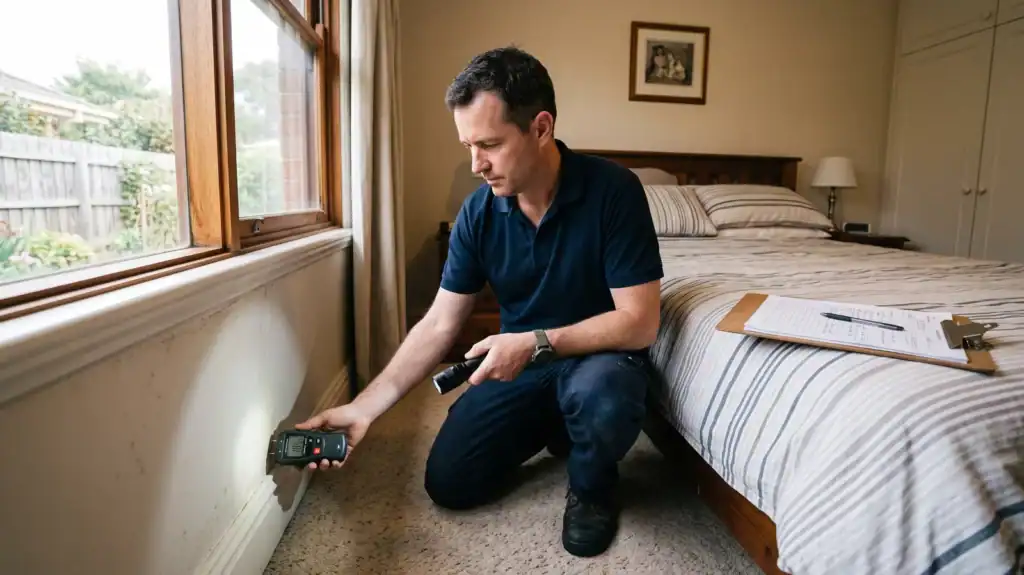
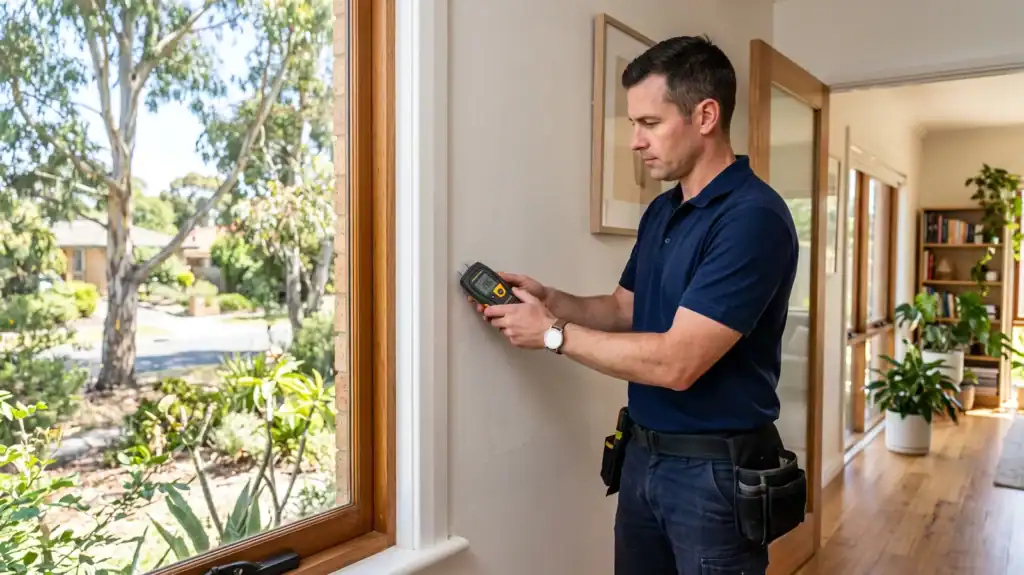
That musty, damp smell in your home is almost certainly mould growing somewhere you cannot see.
Mould produces volatile organic compounds called mVOCs as it feeds on timber, plaster and carpet. These compounds create a distinctive odour that most people describe as musty, earthy or stale.
This article covers exactly what mould smells like, where hidden colonies grow, why the smell returns after DIY cleaning, and when to book a professional inspection. If you can smell something off in your home, the answer is probably growing behind the wall.
What Does Mould Smell Like?
Mould has a musty, earthy smell often compared to damp clothes left in the washing machine or a forgotten wet towel. The odour comes from microbial volatile organic compounds (mVOCs) that mould colonies release as they break down organic materials in your home.
Different mould species produce slightly different smells, but that stale, damp quality is the common thread. If you walk into a room and notice a smell that was not there before, or one that fades when you open a window and returns once you close it, mould is the most likely source.
- Musty or stale, like a damp basement or old books
- Earthy, similar to soil or rotting wood
- Sour or tangy, resembling vinegar or sour milk
- Sweet and rotten, particularly with black mould species
- Damp fabric, like wet clothes left in the machine overnight
The strength of the smell depends on how large the colony is and how confined the space. A faint whiff behind a cupboard could mean early growth.
A persistent smell that hits you when you walk through the door usually means the colony is well established. It is likely growing inside the wall cavity, ceiling space or under flooring where no amount of surface cleaning will reach it.
The smell often gets stronger after rain or when you return home after a few days away. Rain drives moisture into wall cavities and subfloors, feeding dormant colonies. A sealed house with no ventilation lets mVOC concentrations build up in the still air.
Where Does the Mould Smell Come From?
The smell is caused by mVOCs (microbial volatile organic compounds). These are gases that mould releases as it digests organic materials like timber framing, plasterboard paper, carpet backing and dust.
According to the US Environmental Protection Agency, mVOCs are responsible for the characteristic musty odour associated with mould growth in buildings.
| Compound | Typical smell | Common source |
|---|---|---|
| 1-Octen-3-ol | Mushrooms, damp earth | Most mould species |
| Geosmin | Freshly turned soil | Penicillium, Aspergillus |
| 2-Methylisoborneol | Musty, stale | Water-damaged materials |
| 3-Methyl-1-butanol | Sour, fermented | Stachybotrys (black mould) |
You do not need to identify the exact compound. The point is simple: if you can smell it, mould is actively growing and releasing these compounds into your indoor air.
Cleaning the visible surface with bleach or vinegar does not stop mVOC production. The mould roots (hyphae) embedded in the material beneath continue to grow and release gases regardless.
What Does Black Mould Smell Like?
Black mould (Stachybotrys chartarum) smells sharper and more pungent than common household moulds. It carries a chemical edge that gets worse in enclosed or poorly ventilated spaces.
- Rotting wood or damp cardboard left in a sealed room
- A sharp, chemical undertone beneath the mustiness
- More intense than the smell from white or green mould species
If the musty smell in your home has a strong or acrid quality, black mould may be the cause. For help identifying it by sight, read our guide on what black mould looks like and how to identify it.
Common Places Hidden Mould Grows in Your Home
Many homeowners across Newcastle and the Central Coast only notice mould when it becomes visible on a wall or ceiling. By then, the colony has already spread through the substrate beneath. Coastal humidity makes this worse, which is why Central Coast homes are particularly prone to mould.
The smell often appears weeks before any visible signs. Here are the most common hiding spots.
- Wall cavities behind bathroom tiles, kitchen splashbacks and external walls
- Ceiling spaces above bathrooms and laundries where steam rises and condenses
- Under carpet and underlay, particularly on concrete slab floors
- Inside wardrobes and cupboards on external walls with poor airflow
- Behind furniture pushed tight against walls, trapping moisture
- Subfloor areas in older homes with inadequate ventilation
- Air conditioning ducts and filters that trap moisture and dust (why mould in your air conditioner keeps spreading)
If you can smell mould but cannot see it, the colony is likely growing inside a wall cavity, ceiling space or under flooring. A professional mould inspection identifies the exact source that surface cleaning will never reach.
Is the Smell of Mould Harmful?
The mVOCs that produce the musty smell are themselves an irritant. According to the US Environmental Protection Agency, breathing in mVOCs can cause headaches, nausea, dizziness and nasal irritation, even before visible mould is found.
Mould spores in the air can also trigger mould allergy symptoms including sneezing, congestion and irritated eyes. Anyone with asthma or a respiratory condition is at higher risk.
- If you can smell it, you are breathing in both mVOCs and mould spores
- Sleeping in a musty room means hours of uninterrupted exposure
- Air freshener masks the odour but does nothing about the spores themselves
Why the Mould Smell Keeps Coming Back After Cleaning
This is the part most people get wrong. Spraying bleach or vinegar on visible mould removes the surface discolouration within minutes.
The smell fades temporarily because you have disturbed the surface colony. But the mould roots (hyphae) embedded in the plasterboard, timber or grout beneath are completely unaffected by surface-level cleaning products.
- Bleach kills surface mould on non-porous materials but cannot penetrate porous substrates like plasterboard or timber
- Vinegar disrupts surface growth but does not reach the root structure embedded in the material
- Tea tree oil has some antifungal properties on contact but evaporates quickly, leaving roots intact
- Sugar soap removes surface staining but has no antifungal action at all
Regrowth typically occurs within two to six weeks. The smell returns because the colony was never actually eliminated.
Meanwhile, disturbing mould without proper containment spreads spores through the property. You may clear one wall and unknowingly start new colonies in other rooms.
Retail mould cleaning products are designed for minor surface mould on bathroom tiles. They are not designed for mould growing inside walls, in ceiling cavities or through carpet underlay.
Why DIY Mould Removal Does Not Work Long Term
DIY mould treatment fails for three reasons that no retail product can solve. Homeowners across Lake Macquarie and the Hunter Valley spend months cycling through products before realising the problem is getting worse.
- Surface-only treatment. Every product you can buy at the supermarket works on contact with the surface. Mould growing inside the substrate is physically out of reach.
- No moisture source identification. Mould needs moisture to grow. If you clean the mould but do not find and fix the moisture source (leaking pipe, poor ventilation, rising damp), regrowth is guaranteed.
- Spore dispersal. Scrubbing or spraying mould without containment sends spores airborne. You may clear one wall and unknowingly seed three new colonies elsewhere in the property.
The Mould and Hygiene Solutions team sees this pattern regularly. The musty smell disappears for a few weeks after cleaning, then comes back stronger.
The NSW Department of Health recommends professional assessment when mould covers an area larger than one square metre or returns after cleaning. Surface scrubbing is not a long-term solution.
What Professional Mould Treatment Does Differently
Professional mould removal starts with a thorough inspection to locate every affected area, including hidden growth inside walls and ceiling cavities. The moisture source driving the mould is identified and addressed before any treatment begins.
The treatment itself uses an Australian-made, non-hazardous, non-corrosive and environmentally friendly antimicrobial solution that penetrates the substrate and eliminates the root structure. This is not a product you can buy at Bunnings.
- Penetration: professional antimicrobial solutions are applied to penetrate the substrate and kill the root structure, well below the visible surface
- Containment: proper containment prevents spore dispersal during treatment, something DIY methods cannot replicate
- Moisture source: a professional inspection identifies the moisture source driving growth, rather than treating the symptom alone
- Guarantee: Mould and Hygiene Solutions backs every treatment with an unconditional 12-month mould-free guarantee, because the treatment actually works at the root level
The guarantee matters because it forces accountability. If the mould returns within 12 months, the treatment is repeated at no additional cost.
No retail product offers anything close to that. That confidence only comes from a process that treats the cause, not the surface.
When to Book a Professional Mould Inspection
If you can smell mould in your home, do not wait for visible signs to appear. The smell means active growth, and the longer you leave it, the further the colony spreads through your walls, ceilings and flooring.
Book a professional mould inspection if you notice any of these signs.
- A persistent musty smell that does not go away with cleaning or ventilation
- Visible mould that returns within weeks of cleaning
- Mould in more than one room or on multiple surfaces
- Discolouration or bubbling on walls or ceilings
- Condensation on windows or walls, particularly in winter
- Any water damage, flooding or a plumbing leak
Mould and Hygiene Solutions provides professional mould inspections across Newcastle, the Central Coast, Lake Macquarie, Hunter Valley and Port Stephens. The inspection identifies every affected area, the moisture source, and the right treatment plan for your property.
Contact the team to book your inspection.
Frequently Asked Questions
How do I know if a smell in my house is mould?
If the smell is musty, damp or earthy and gets stronger in enclosed spaces or after rain, it is almost certainly mould. It tends to concentrate around bathrooms, wardrobes and subfloor areas, and persists even after opening windows.
What should I do if I smell mould but cannot find it?
The colony is likely inside a wall cavity, ceiling space or subfloor. A professional mould inspection uses moisture mapping equipment to locate hidden growth without tearing into walls.
Is it bad to sleep in a room that smells like mould?
You are breathing in spores and mVOCs all night, which can trigger or worsen congestion, coughing and headaches. Ventilate the room and arrange a professional inspection to find the source.