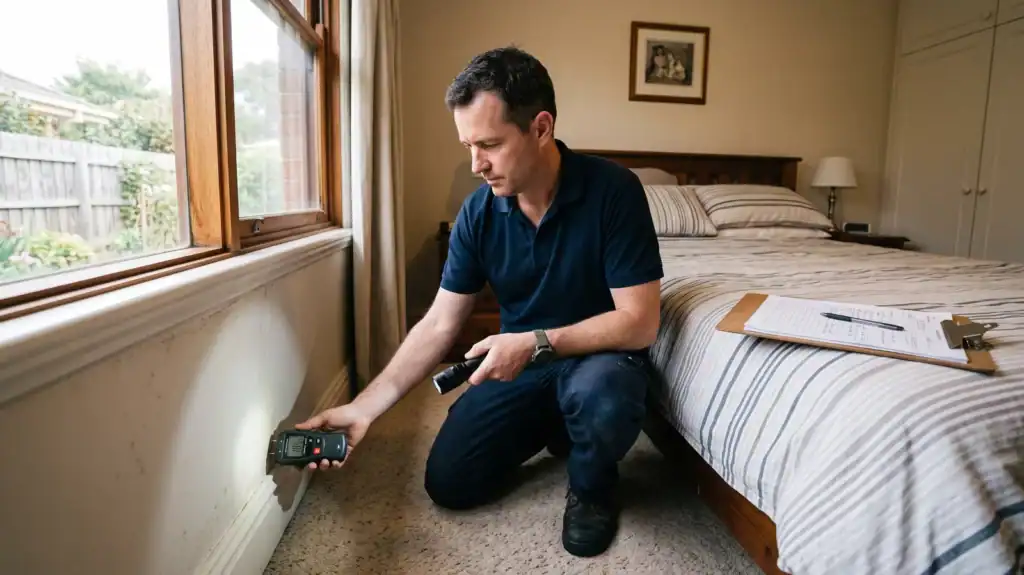
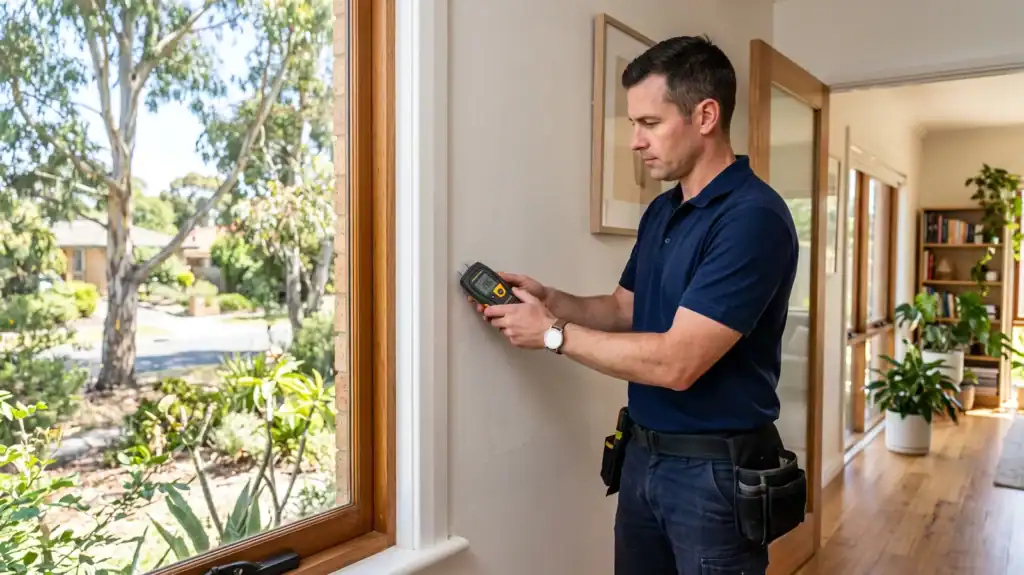
DIY mould removal treats what you can see, but it does not touch the root structure growing underneath.
Most homeowners across Newcastle and the Central Coast reach for bleach or vinegar the moment they spot mould on a wall or ceiling. It makes sense. The stain disappears, the surface looks clean, and the problem appears solved.
This article breaks down exactly what happens when you clean mould yourself, why it keeps coming back, and what professional mould removal actually involves. By the end, you will understand why surface cleaning is only half the job.
Already dealing with recurring mould? Book a free mould inspection with Mould and Hygiene Solutions to find out what is growing beneath the surface. You can also learn more about our mould removal process.
What Happens When You Clean Mould Yourself
When you spray bleach or vinegar on a mould patch, the visible discolouration disappears within minutes. That is because household cleaning products break down the pigment on the surface layer of the colony.
The problem is underneath. Mould grows root-like filaments called hyphae that penetrate deep into porous materials such as plasterboard, timber framing and grout.
Retail cleaning products cannot reach those roots. The hyphae remain embedded in the substrate, and regrowth typically starts within two to six weeks.
- Bleach removes surface discolouration but does not penetrate porous materials
- Vinegar kills some surface mould species but leaves the root structure intact
- Scrubbing without containment releases thousands of spores into the air
- No household product addresses the moisture source driving the growth
This is why homeowners often describe a cycle of cleaning and regrowth. The colony was never eliminated. It was trimmed.
Why Mould Keeps Coming Back After DIY Removal
Recurring mould is not a cleaning problem. It is a moisture problem combined with incomplete treatment.
DIY mould removal fails for three specific reasons, and understanding them explains why the same spot keeps growing back no matter how many times you clean it.
- Root survival: Hyphae embedded in plasterboard, timber or grout are not affected by surface-level sprays. The colony regrows from these surviving roots.
- Spore dispersal: Scrubbing and wiping without proper containment spreads airborne spores to other rooms. You solve one patch and create three more.
- Unresolved moisture: Mould needs moisture to grow. Retail products do nothing about the condensation, leak or ventilation failure feeding the colony.
Until all three factors are addressed at once, the mould will return. That is not an opinion. It is how the organism works.
If you have cleaned the same mould patch more than once, the root structure has survived every attempt. A professional mould test can confirm what species you are dealing with and how deep the colony extends.
DIY vs Professional Mould Removal Compared
The difference between DIY and professional mould removal comes down to depth of treatment. One addresses the surface. The other addresses the entire colony, the spore load and the moisture source.
| Factor | DIY Cleaning | Professional Treatment |
|---|---|---|
| Surface mould removed | Yes | Yes |
| Root structure (hyphae) eliminated | No | Yes, antimicrobial penetrates substrate |
| Airborne spores contained | No, scrubbing disperses spores | Yes, containment procedures used |
| Moisture source identified | Rarely | Yes, included in inspection |
| Regrowth prevention | None | Antimicrobial barrier applied |
| Guarantee | None | 12-month mould-free guarantee |
| Cost per attempt | $10 to $30 in products | Single professional fee |
| Total cost over 12 months | Multiple repeat treatments | One treatment, guaranteed |
The upfront cost of professional treatment looks higher. Factor in repeat purchases of retail products, time spent cleaning every few weeks, and the risk of structural damage from untreated growth, and the numbers shift.
What Professional Mould Removal Actually Involves
Professional treatment follows a structured process designed to eliminate the colony at every level. At Mould and Hygiene Solutions, every job is completed by the owner, James, using an Australian-made, non-hazardous, non-corrosive and environmentally friendly antimicrobial solution.
This is not a surface spray. The antimicrobial penetrates into porous substrates where hyphae are embedded and kills the root structure that household products cannot reach.
The Treatment Process
- Inspection: A thorough assessment of the affected areas, including hidden spaces behind walls and in ceiling cavities, to map the full extent of the colony
- Moisture source identification: Finding and documenting the condensation, leak or ventilation issue driving the mould growth
- Containment: Isolating the work area to prevent spore dispersal to unaffected rooms during treatment
- Antimicrobial treatment: Application of the antimicrobial solution that penetrates the substrate and eliminates the root structure
- Preventive barrier: A protective coating that resists future mould colonisation on treated surfaces
The entire process is backed by an unconditional 12-month mould-free guarantee. If mould returns to any treated area within that period, Mould and Hygiene Solutions retreats it at no charge.
That guarantee exists because the treatment works at the root level. No DIY product on the market offers anything comparable.
Health Risks of Incorrect Mould Removal
Disturbing a mould colony without proper containment is a health risk that most homeowners underestimate. Scrubbing, wiping and spraying release concentrated bursts of spores into the air you breathe.
The Victorian Department of Health advises that people with weakened immune systems, chronic lung conditions, and young children should not be present during mould removal. That advice applies to DIY cleaning just as much as professional work.
- Airborne spore counts spike dramatically during uncontained scrubbing
- Inhaled spores can trigger respiratory symptoms, allergic reactions and asthma flare-ups
- Mould species like Stachybotrys (black mould) produce mycotoxins that remain on surfaces after the colony is cleaned
- Mixing bleach with other cleaning products can release toxic chlorine gas
- Inadequate ventilation during DIY cleaning concentrates both spores and chemical fumes
Professional mould remediation includes containment and air filtration specifically to manage these risks. DIY cleaning has no equivalent safeguard.
When to Call a Professional for Mould Removal
Not every small patch of surface mould requires professional treatment. But there are clear indicators that the problem has moved beyond what a spray bottle can handle.
If any of the following apply, DIY mould removal will not resolve the issue.
- Mould covers an area larger than one square metre
- The same spot has returned after previous cleaning
- There is a musty smell even when no mould is visible
- Mould is growing on structural materials such as timber framing or behind plasterboard
- Anyone in the household is experiencing unexplained respiratory symptoms
- The property has experienced water damage, flooding or persistent condensation
Homeowners across Newcastle, Lake Macquarie, the Central Coast, Hunter Valley and Port Stephens can book a free mould inspection with Mould and Hygiene Solutions. The inspection identifies the species, the extent of growth and the moisture source, with no obligation.
Stop Cleaning and Start Treating
DIY mould removal products exist to sell you a quick fix. They work on the surface, and the surface is not where the problem lives.
Every time you spray and wipe, the hyphae underneath survive, the moisture source remains, and the colony rebuilds. The cycle only breaks when the root structure is eliminated and the conditions that support growth are corrected.
Mould and Hygiene Solutions treats every property with an Australian-made, non-hazardous, non-corrosive and environmentally friendly antimicrobial solution that reaches the substrate where roots are embedded. Every job is backed by an unconditional 12-month mould-free guarantee.
If you have found mould in your home or business, the most effective first step is a professional inspection. Contact Mould and Hygiene Solutions to book your free inspection across Newcastle, the Central Coast, Lake Macquarie, Hunter Valley and Port Stephens.