Keep indoor humidity below 60% and mould cannot establish itself.
That is the number every Australian homeowner needs to know. Most properties across Newcastle, the Central Coast and the Hunter Valley sit well above that threshold for months at a time, particularly between October and March.
The combination of warm temperatures and coastal moisture creates conditions where mould colonies can take hold within 24 to 48 hours. This article breaks down the specific humidity ranges that matter, explains why monitoring alone is not enough, and covers what actually stops mould from returning once it has started growing in your walls and ceilings.
If you have visible mould in your home, humidity control alone will not fix it. The root structure is already embedded in the substrate. Book a free mould inspection with Mould and Hygiene Solutions to assess the damage.
The Three Humidity Zones You Need to Understand
Indoor relative humidity falls into three distinct risk categories for mould growth. A $15 hygrometer from Bunnings will tell you exactly where your home sits right now.
- Below 50% RH — Safe zone. Mould spores cannot germinate or form colonies. This is the target range recommended by the US Environmental Protection Agency and Australia’s National Asthma Council.
- 50% to 60% RH — Caution zone. Most mould species remain dormant, but Aspergillus and a handful of xerophilic (dry-loving) species can begin growing on dust-covered surfaces at the upper end of this range.
- Above 60% RH — Active growth zone. At 60% and above, the majority of indoor mould species have enough moisture to germinate, colonise and reproduce. Above 70%, growth accelerates and can become visible within days.
| Humidity Range | Risk Level | What Happens |
|---|---|---|
| Below 50% | Low | Spores dormant, no active growth |
| 50–60% | Moderate | Some species can begin colonising |
| 60–70% | High | Most species actively growing |
| Above 70% | Severe | Rapid colonisation and spread |
The problem for homeowners in Lake Macquarie and the Central Coast is that outdoor humidity regularly exceeds 75% during summer. Without active ventilation or dehumidification, indoor levels mirror outdoor conditions within hours.
Why 60% Is the Humidity Level That Matters for Mould
Research published in Building and Environment journal confirmed that relative humidity is more important than temperature for indoor mould prevention. The study tested Cladosporium cladosporioides (one of the most common indoor mould species in Australia) and found that survival rates dropped substantially when humidity cycled below 40%.
The EPA sets the threshold at 60% for a reason. Below this level, mould spores lack the water activity needed to penetrate building materials and establish root structures called hyphae.
- Mould requires a water activity level of 0.7 or higher to germinate
- Standard gyprock (plasterboard) reaches this water activity at roughly 60-65% RH
- Timber framing reaches it at around 70% RH
- Bathroom tiles and grout reach it at lower humidity because grout is porous and retains moisture
Here is where DIY humidity monitoring falls short. A hygrometer on the kitchen bench reads the air in the centre of the room.
The air inside your wall cavity, behind your wardrobe, and underneath your subfloor is a different story. These concealed spaces trap moisture and maintain humidity levels 10 to 20 percentage points higher than the room itself.
A dehumidifier running in your lounge room does not address moisture trapped inside wall cavities or beneath flooring. That requires professional mould testing to identify hidden moisture sources.
What Humidity Monitoring Cannot Fix
Buying a dehumidifier and a hygrometer is the first thing most people do when they spot mould. It is a reasonable instinct, but it addresses the symptom and misses the cause.
Humidity monitoring tells you the conditions in your living space right now. It does not tell you:
- Whether moisture is entering through the slab, subfloor or roof cavity
- Whether condensation is forming inside wall cavities where warm indoor air meets cold external walls
- Whether your bathroom exhaust fan actually vents outside or just recirculates into the ceiling space
- Whether previous water damage has left moisture trapped in building materials
A home in Port Stephens can read 48% on the hygrometer in the living room while the gyprock behind the bed head is saturated at 85% moisture content. That is where mould grows: not in the air you are measuring, but in the materials you cannot see.
DIY mould sprays and bleach solutions address what is visible on the surface. Bleach oxidises the pigment in mould, turning it white, and the surface appears clean.
The hyphae (root structures) embedded 2 to 3 millimetres into the plasterboard or timber are completely unaffected. Regrowth typically appears within two to six weeks.
Why DIY Mould and Humidity Control Fails Long Term
Every hardware store sells dehumidifiers, moisture absorbers and mould-killing sprays. These products have a role, but treating them as a solution leads to a repeating cycle that homeowners across the Hunter Valley know well: clean it, watch it return, clean it again.
Here is why the cycle continues:
- Surface cleaning does not reach the root structure. Vinegar, bleach, tea tree oil and commercial mould sprays only contact the surface. The mycelium network inside the material remains alive and begins reproducing immediately.
- Retail dehumidifiers cannot address structural moisture. A portable dehumidifier pulls moisture from the air in one room. It cannot extract moisture from inside a concrete slab, a waterlogged wall cavity, or a poorly ventilated subfloor.
- The moisture source is never identified. Mould does not appear randomly. There is always a moisture source: a leaking pipe, rising damp, inadequate drainage, condensation from poor insulation, or failed waterproofing.
- Disturbing mould without containment spreads spores. Scrubbing mould with a brush or spraying it aggressively releases millions of spores into the air. These settle on other surfaces throughout the property and start new colonies.
- Bleach kills surface mould but does not penetrate substrates
- Vinegar is mildly antifungal on non-porous surfaces only
- Tea tree oil has no proven efficacy on porous building materials
- Moisture absorber crystals manage small spaces like wardrobes, not rooms
The pattern is always the same: treat the surface, feel relieved, watch it return in four to eight weeks, repeat. The mould keeps winning because the root system and the moisture source are never addressed.
What Professional Mould Treatment Does Differently
Professional mould removal follows a fundamentally different approach from surface cleaning. The entire process targets the substrate where mould roots live, rather than wiping the visible surface.
Mould and Hygiene Solutions uses an Australian-made, non-hazardous, non-corrosive and environmentally friendly antimicrobial solution that penetrates into the substrate. The solution is applied under controlled conditions with proper containment to prevent cross-contamination.
The process involves four stages that DIY methods skip entirely:
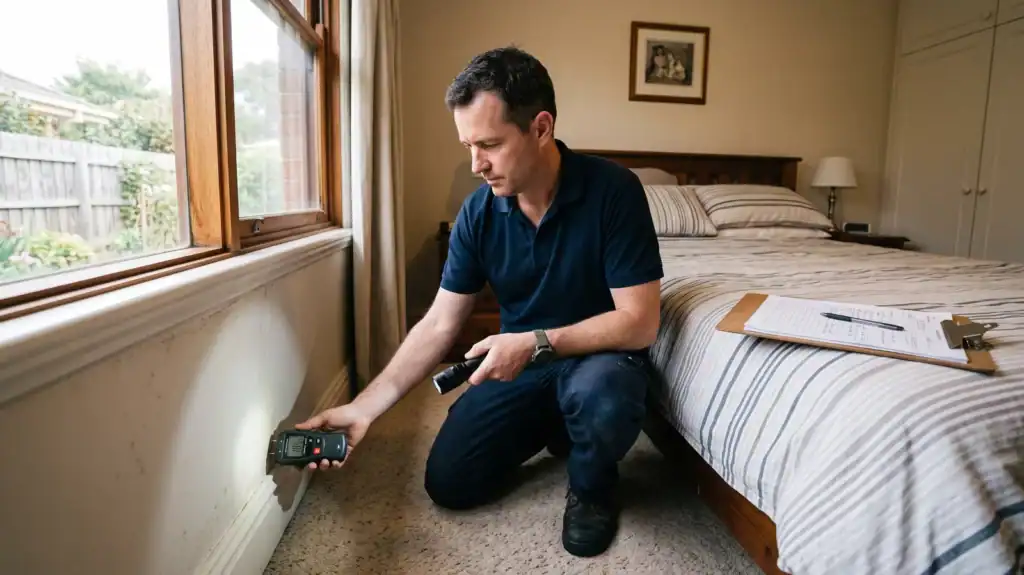
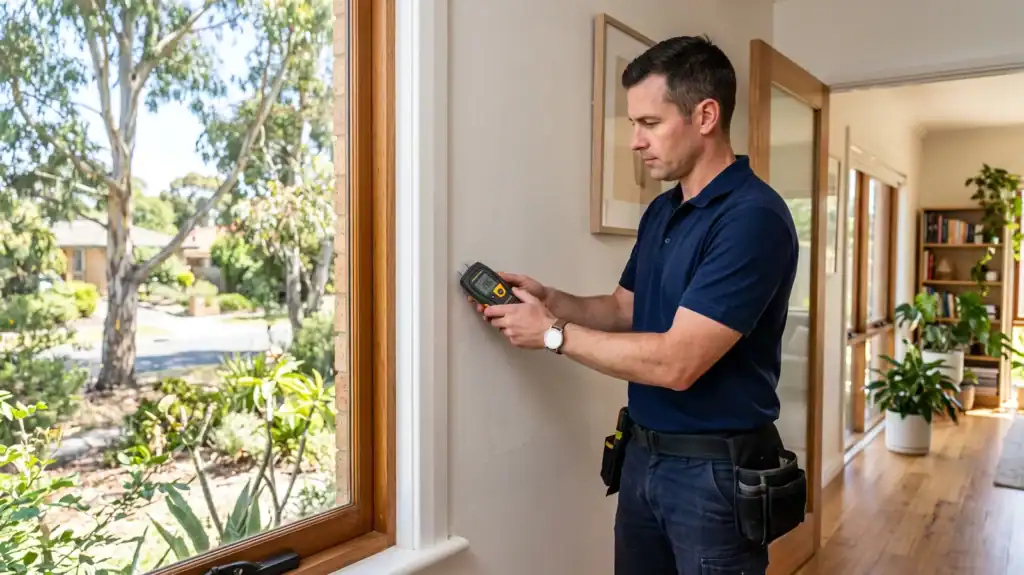
- Moisture source identification — Using thermal imaging and moisture meters to locate exactly where water is entering the building materials. No treatment is effective until this is found.
- Containment — Isolating the affected area to prevent spore dispersal during treatment. This is the step most DIY attempts skip, spreading the problem to other rooms.
- Substrate treatment — Applying the antimicrobial solution to penetrate into the material and destroy the root structure, not the visible surface growth alone.
- Prevention — Addressing the moisture source and applying protective treatment to prevent recolonisation.
| Approach | Targets Surface | Targets Roots | Identifies Moisture Source | Prevents Regrowth |
|---|---|---|---|---|
| Bleach spray | Yes | No | No | No |
| Vinegar | Partially | No | No | No |
| Commercial spray | Yes | No | No | No |
| Dehumidifier | N/A | No | No | Partially |
| Professional treatment | Yes | Yes | Yes | Yes |
This is why Mould and Hygiene Solutions offers an unconditional 12-month mould-free guarantee. The treatment works at the level where mould actually lives.
Practical Steps to Reduce Indoor Humidity Levels
While professional treatment is the only way to eliminate established mould, managing indoor humidity reduces the risk of new colonies forming on treated surfaces. These steps manage the environment but do not fix existing mould damage.
- Run bathroom exhaust fans for 20 minutes after every shower, and verify they actually vent to the outside (many older homes in Newcastle recirculate into the roof cavity)
- Open windows on opposite sides of the house for 15 minutes daily to create cross-ventilation, even in winter
- Keep furniture 50 to 100 millimetres away from external walls to allow air circulation behind wardrobes and bed heads
- Use a dehumidifier in rooms that consistently exceed 60% RH, but understand this manages air moisture only
- Fix dripping taps, leaking gutters and blocked downpipes immediately
- Dry clothes outside or in a vented dryer, never on indoor racks (a single load of wet washing releases up to 5 litres of moisture into the air, according to the National Asthma Council)
If you can see mould on a surface, the colony underneath is already established. Surface cleaning will not remove it permanently.
The average Australian bathroom generates over 1.5 litres of moisture per shower. Without proper extraction, this moisture migrates into wall cavities and ceiling spaces where it feeds mould colonies you cannot see.
When to Stop Managing and Start Treating
If you are reading this article, you have probably already tried the DIY approach. The question is whether your situation needs professional intervention.
- Mould returns within weeks of cleaning — the root structure is intact and regrowing
- You can smell a musty odour but cannot see visible mould — the colony is hidden inside wall cavities or under flooring
- Mould appears in multiple rooms — spores have spread beyond the original site
- Someone in the household has worsening respiratory symptoms, allergies or sinus issues — airborne spore counts may be elevated
- The affected area exceeds one square metre — the EPA recommends professional mould remediation for areas this size and larger
If you have found mould in your home or business, the most effective first step is a professional inspection. Mould and Hygiene Solutions offers free inspections across Newcastle, the Central Coast, Lake Macquarie, Hunter Valley and Port Stephens.
A proper assessment identifies the moisture source, maps the extent of the colony, and determines whether the materials can be treated or need replacement. Book your free inspection today.