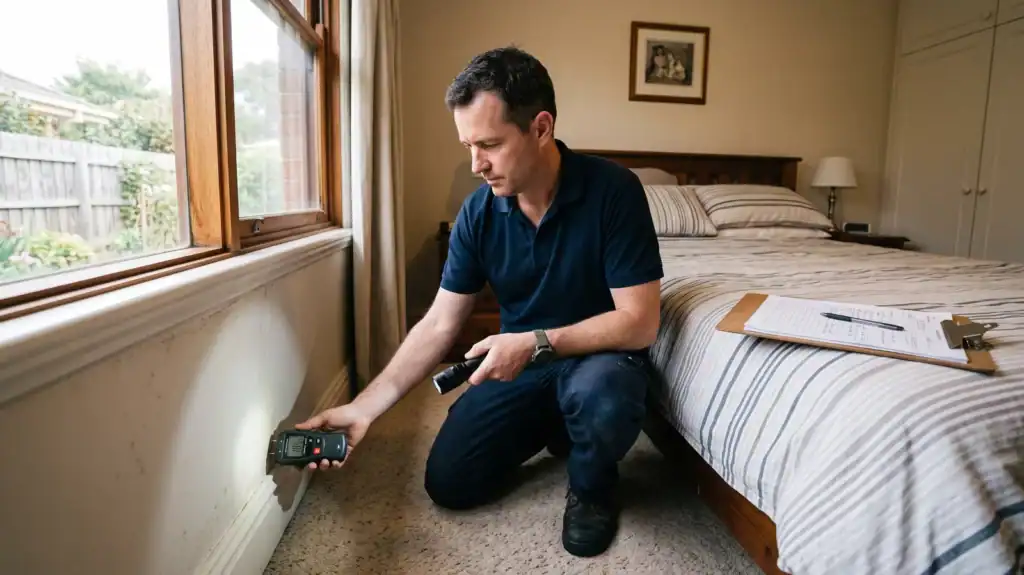
Condensation gives mould the moisture it needs to colonise your walls, ceilings, and window frames.
Every winter, homeowners across Newcastle and the Central Coast see condensation mould forming on their windows, walls, and ceilings. Most wipe the moisture away and forget about it.
By the time mould becomes visible, the colony has already grown into the material underneath. This article explains how winter condensation feeds that growth, where it shows up first, and why professional treatment is the only approach that lasts.
Already spotted mould in your home? Mould and Hygiene Solutions offers professional mould inspections across Newcastle, the Central Coast, Lake Macquarie, Hunter Valley, and Port Stephens.
How Condensation Turns Into Mould Growth
Warm air holds more moisture than cold air. When heated indoor air hits a cold surface like a window, exterior wall, or tile, it drops below its dew point and releases water droplets.
That moisture soaks into porous materials like plaster, timber, and grout. Mould spores, which exist in every home, only need sustained dampness and an organic surface to start colonising.
Once a surface stays damp for 24 to 48 hours, mould begins growing into the substrate. The visible patches are just the fruiting body, while the root structure (hyphae) has already spread beneath the paint or plaster.
This is why wiping mould off or spraying bleach does not solve the problem. You remove what you can see, but the roots stay embedded in the material and regrow within weeks.
- Indoor humidity above 60% (the mould-risk threshold identified by the World Health Organisation) from cooking, showering, and drying clothes inside
- Cold exterior walls and single-glazed windows acting as condensation surfaces
- Poor ventilation trapping moisture-laden air in bathrooms, laundries, and bedrooms
- Unflued gas heaters adding roughly 1 litre of water vapour per hour to indoor air
Worth knowing: The Victorian Building Authority confirms that unflued gas heaters release approximately 1 litre of water into indoor air for every hour of operation. In winter, this makes them one of the largest contributors to condensation in Australian homes.
Where Condensation Mould Appears First in Your Home
Mould does not appear randomly. It follows the coldest, least ventilated surfaces in your home.
- Bedroom windows and sills. Overnight breathing adds moisture to closed rooms, and single-glazed glass is the coldest surface available. Once moisture settles on the sill and surrounding wall, mould in bedrooms spreads behind headboards and curtains where airflow is blocked.
- Bathroom ceilings and walls. Steam from showers saturates surfaces that rarely dry completely between uses.
- Wardrobes against exterior walls. The gap between furniture and the wall traps still, humid air with no airflow to dry it.
- Laundry walls. Dryers vented indoors push warm, wet air directly into a confined space.
- Ceiling corners. Where two cold surfaces meet, air circulation drops to almost nothing. Left unchecked, condensation mould on ceilings spreads across the entire surface and into the substrate beneath the paint.
Homeowners across the Hunter Valley and Lake Macquarie see this pattern every winter. Coastal humidity stays high even on cold days, which means indoor moisture has nowhere to escape.
Why Surface Cleaning Does Not Stop Condensation Mould
Most homeowners reach for bleach or vinegar when they spot mould on a wall or window frame. These products remove the surface discolouration within minutes.
The mould root system embedded in the plaster, grout, or timber underneath is unaffected. Regrowth typically appears within two to six weeks because the root structure was never disturbed.
There is a second problem with DIY removal. Disturbing mould without proper containment releases spores into the air, and those spores settle on other damp surfaces throughout the home and start new colonies.
The root cause of condensation mould is always a moisture problem. No retail product addresses the moisture source, which means the mould keeps returning no matter how many times you clean it.
| DIY (Bleach/Vinegar) | Professional Treatment | |
|---|---|---|
| Treats surface mould | Yes | Yes |
| Reaches root structure in substrate | No | Yes |
| Prevents spore spread during removal | No | Yes (containment procedures) |
| Identifies moisture source | No | Yes (inspection report) |
| Backed by written guarantee | No | Yes (12-month mould-free guarantee) |
What Professional Mould Treatment Actually Does
Professional mould removal works differently from anything available at a hardware store. Mould and Hygiene Solutions uses an Australian-made, non-hazardous, non-corrosive and environmentally friendly antimicrobial solution that penetrates the substrate to destroy the root structure.
The process starts with a thorough inspection to identify every affected area and the moisture source driving the growth. Without addressing the moisture source, any treatment is temporary.
- Full property inspection with a written report detailing every affected area
- Containment procedures to prevent cross-contamination during treatment
- Antimicrobial treatment that penetrates the substrate to kill root structures
- Moisture source identification and practical recommendations to stop recurrence
- 12-month mould-free guarantee on all treated areas
The 12-month guarantee is straightforward. If mould returns in any treated area within that period, the treatment is redone at no additional cost.
Reducing Condensation Before It Leads to Mould
Lowering indoor condensation helps slow mould growth. These steps reduce your risk, though ventilation changes alone cannot reverse an established mould colony.
- Run bathroom and kitchen exhaust fans for at least 20 minutes after cooking or showering
- Open windows on opposite sides of the home during the driest part of the day, typically between 10am and 2pm
- Keep a 50mm gap between furniture and exterior walls so air can circulate behind them
- Avoid drying clothes indoors without opening a window or running a dehumidifier
- Replace unflued gas heaters with flued or electric alternatives where possible
- Use a hygrometer to monitor indoor humidity and keep it below 60%
These habits reduce the moisture that feeds condensation. If condensation returns every winter despite these measures, the problem is usually structural, and professional mould prevention identifies the moisture paths and ventilation failures that household fixes cannot reach.
If mould has already colonised your walls or ceilings, reducing humidity alone will not remove what is growing inside the substrate.
Winter condensation is the single biggest driver of residential mould across Newcastle, the Central Coast, and the Hunter Valley. Cold surfaces, coastal humidity, and closed-up houses create the conditions where mould colonises fast.
If you have spotted mould this winter, the most effective first step is a professional inspection. Mould and Hygiene Solutions services properties across Newcastle, the Central Coast, Lake Macquarie, Hunter Valley, and Port Stephens.
Book a mould inspection in the Newcastle region to find out exactly where the moisture is coming from and what it takes to fix it properly.
Frequently Asked Questions
Does condensation always cause mould?
Not by itself. Condensation becomes a mould risk when surfaces stay damp for more than 24 to 48 hours continuously.
Brief condensation that dries within a few hours, like a bathroom mirror after a shower, is not usually a problem. The risk increases when moisture lingers on cold walls, window frames, or ceiling surfaces overnight.
Can I stop condensation mould by opening windows in winter?
Opening windows during the driest part of the day reduces indoor humidity and helps slow new condensation forming. It does not remove mould that has already grown into wall or ceiling substrates.
Why does mould keep coming back after I clean it?
Retail cleaning products only reach surface mould. The root structure remains embedded in the plaster, timber, or grout and regrows within two to six weeks.
Is condensation mould dangerous?
Prolonged exposure to mould spores can aggravate respiratory conditions and trigger allergic reactions in some people. If you can see or smell mould in your home, have it assessed by a professional.
Do dehumidifiers prevent condensation mould?
Dehumidifiers lower indoor humidity, which reduces condensation on cold surfaces. They are a useful preventive tool, though dehumidifiers cannot reverse mould that has already colonised porous surfaces.
What humidity level prevents mould?
Keeping indoor relative humidity below 60% significantly reduces the risk. Most building science guidelines put the target humidity for mould prevention between 30% and 50%.
Does subfloor ventilation help with indoor condensation?
Subfloor ventilation reduces moisture rising from the ground into your floor and wall cavities. In older homes with enclosed subfloors, particularly across the Central Coast and Hunter Valley, it can lower overall indoor humidity.
It does not address condensation caused by cooking, showering, or unflued gas heaters. If mould has already established itself on walls or ceilings, subfloor fans will not reach the root structure growing inside the substrate. The moisture sources above ground need separate treatment.
What causes condensation on the inside of windows in winter?
Cold glass pulls the temperature of the air touching it below its dew point. The moisture in that air turns into water droplets on the glass surface. Single-glazed windows are worst affected because they transfer cold from outside with almost no insulating barrier.
Winter makes this worse because the temperature gap between heated indoor air and cold glass is at its widest. Bedrooms are particularly prone because overnight breathing adds moisture to a closed room while the glass stays cold for hours.