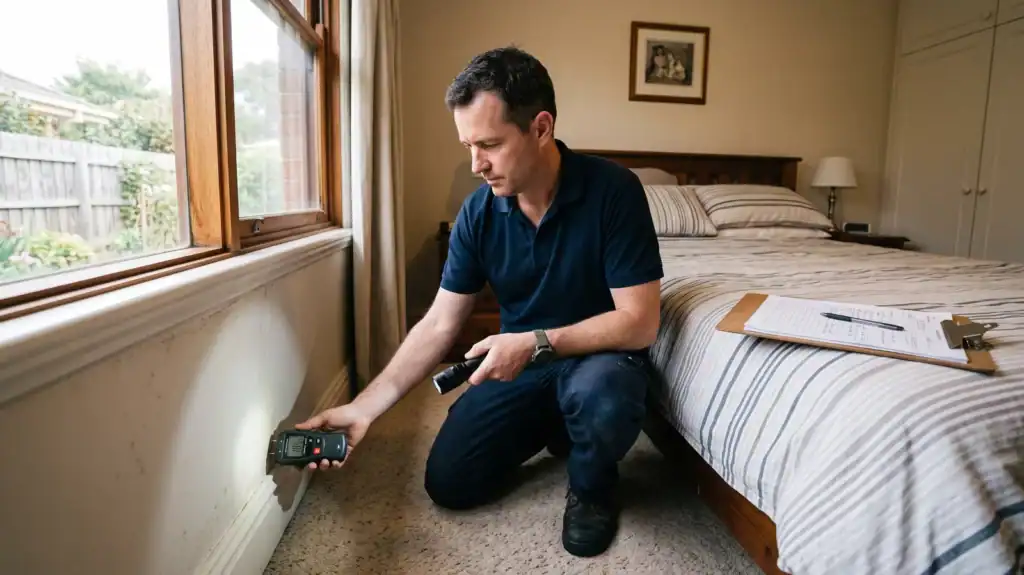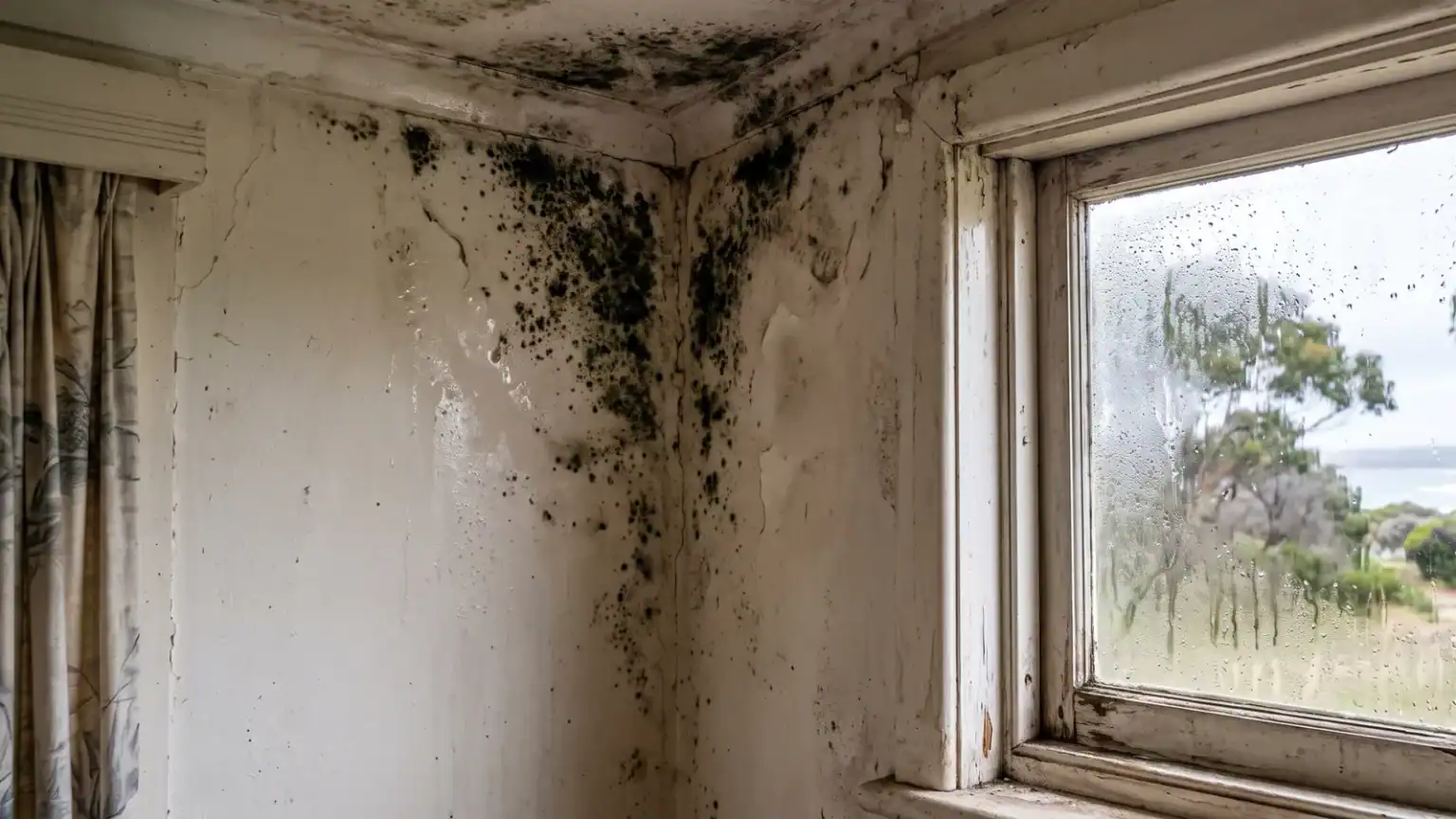
Central Coast homes often face recurring mould because damp materials can struggle to dry.
Long-term Bureau of Meteorology records for Gosford and Narara report 1,328.3 mm of mean annual rainfall and mean relative humidity of 74% at 9 am and 58% at 3 pm. The figures show why moisture management matters here.
Start with the places where moisture enters or gets trapped.
If you are already dealing with mould in your home, learn more about professional mould removal on the Central Coast or book a mould inspection with Mould and Hygiene Solutions.
Why Central Coast Homes Can Stay Damp
The Central Coast lies between the Pacific Ocean, Tuggerah Lakes and Brisbane Water. Local homes deal with frequent rain and slow drying.
The Bureau of Meteorology’s long-term Gosford and Narara records report mean relative humidity of 74% at 9 am and 58% at 3 pm. The station has closed, so these are climate averages rather than a daily reading.
No single outdoor humidity reading proves a home will grow mould. NSW Health points instead to accumulated moisture, damp materials and inadequate ventilation.
The same Bureau of Meteorology records put mean annual rainfall at 1,328.3 mm, with measurable monthly averages throughout the year. After rain, check the roof, gutters, drainage and subfloor for water that is not clearing.
- Humid mornings and rainfall in every month of the long-term record
- Damp subfloors where ground moisture and drainage are poorly managed
- Condensation where moist indoor air meets cold glass, walls or ceilings
- Bathrooms, laundries and kitchens that do not vent moisture outdoors
- Roof, plumbing or gutter leaks that leave materials wet
Why Some Central Coast Homes Struggle With Mould
A home’s age matters less than its construction, maintenance and ability to dry.
Single glazing, missing or poorly installed insulation, blocked subfloor vents and exhaust fans that do not discharge outdoors can all raise condensation risk. Australian Government guidance on condensation says the risk depends on climate, construction and how the home is used.
Raised timber floors deserve particular attention. When vents are blocked, drainage is poor or the ground stays damp, moisture can build beneath the floor and affect nearby timber, carpets and wall linings.
| Building detail | Why it matters | What to check |
|---|---|---|
| Windows and frames | Cold surfaces collect condensation | Morning water on glass, frames and sills |
| Insulation and membranes | Poor installation can leave cold spots or trap moisture | Damp patches, thermal bridges and damaged linings |
| Subfloor ventilation | Still, damp air slows drying below raised floors | Blocked vents, wet soil and plumbing leaks |
| Bathroom and laundry exhaust | Recirculated air leaves moisture indoors | Fans that discharge outside and have adequate airflow |
| Roof and drainage | Leaks keep porous materials wet | Gutters, flashings, roof penetrations and downpipes |
Newer homes can also develop mould when moisture has nowhere to go. If condensation is recurring, these practical ventilation changes for mould prevention explain how exhaust fans, airflow and moisture control work together.
Where Mould Shows Up First in Central Coast Homes
Mould grows where moisture lingers, so some parts of a home tend to show it first.
- Bathroom ceilings and walls. Steam from showers condenses on cooler surfaces, especially in bathrooms without an exhaust fan ducted to the outside.
- Bedroom wardrobes. Clothes storage against an external wall traps air and creates a cold, still pocket where condensation forms.
- Window frames and sills. Single-glazed windows in older homes produce heavy condensation overnight, particularly in winter.
- Subfloor spaces. Raised timber floors in low-lying suburbs accumulate ground moisture that rises into carpets, skirting boards and wall cavities.
- Roof cavities. Poor ventilation in the roof space allows warm, humid air to condense on the underside of roof sheeting.
If you have noticed mould growing on your bathroom ceiling or mould that keeps coming back after you clean it, check for condensation, a leak, damp materials or inadequate airflow rather than assuming cleaning alone has solved it.
How to Tell If Mould Is Already Growing
Mould can be hidden behind linings, beneath flooring or inside roof and subfloor spaces. Start by looking for moisture and material damage.
- A persistent musty smell that does not go away after cleaning or airing out the room. If your home smells musty or damp without an obvious source, mould is likely growing behind a wall, under flooring or inside a cavity.
- Peeling or bubbling paint on walls or ceilings, particularly in bathrooms and laundries. Moisture trapped behind the surface pushes the paint film away from the substrate.
- Condensation on windows every morning. Consistent window condensation means indoor humidity is too high. That same moisture is settling on cooler surfaces throughout the house.
- Dark spots in corners, around window frames or along ceiling edges. These may be surface growth, but an inspection is needed to determine whether moisture extends into the material beneath.
- Water stains, swollen skirting or soft plasterboard. Material changes can reveal a roof, plumbing or drainage problem even when mould is not yet obvious.
If several of these signs appear together, a professional assessment can trace moisture and inspect areas that are not visible. NSW Health cautions that health symptoms alone are not a reliable indicator of mould, so the building itself needs to be checked.
Why Surface Cleaning Does Not Fix Central Coast Mould
Cleaning a small visible patch may remove surface growth, but the job is incomplete if the wall, ceiling or subfloor stays damp.
Porous materials complicate the job because contamination and moisture can extend below the face you can reach. NSW Health notes that absorbent materials such as mould-contaminated carpet may need professional cleaning or replacement.
If the material stays damp, the mould is likely to return. NSW Health recommends treating the cause of the dampness as well as the visible growth.
Larger or hidden mould jobs need controlled work practices. Disturbing affected materials can release spores and debris, so containment and appropriate protective equipment matter during professional remediation.
A surface clean leaves these problems untouched:
- Moisture behind or beneath the visible surface
- Contaminated porous material that cannot be wiped clean
- The leak, condensation or ventilation problem driving the growth
Our guide explains why DIY mould removal often fails when the underlying moisture problem remains.
What Professional Mould Treatment Does Differently
A professional mould removal service should identify the moisture source as well as remove the mould. Without fixing the cause, any treatment is temporary regardless of what product is used.
Mould and Hygiene Solutions uses an Australian-made, non-hazardous, non-corrosive antimicrobial solution as part of its treatment process. The work is backed by a 12-month mould-free guarantee.
A full mould remediation approach shapes the treatment plan around the affected materials and the moisture source.
- Full property inspection to identify all mould-affected areas and moisture sources
- Containment of affected areas to prevent spore dispersal during treatment
- Application of the antimicrobial treatment specified for the affected surfaces
- Inspection for visible mould and likely moisture sources
- A 12-month mould-free guarantee on completed treatment
After treatment, see how indoor humidity affects mould prevention. Professional treatment addresses the existing colony, while ongoing mould prevention measures stop the next one from taking hold.
Frequently Asked Questions
Why is mould worse on the Central Coast than in western Sydney?
The Bureau of Meteorology’s long-term Gosford and Narara records show humid mornings and about 1,328 mm of mean annual rainfall. That does not prove every Central Coast home is worse than every western Sydney home. Leaks, drainage, ventilation and construction decide what happens indoors.
Does living near the coast cause more mould?
Living near the coast does not cause mould by itself. Mould needs moisture, so the practical questions are whether humid air is condensing indoors, rain is entering the building, or damp areas are failing to dry.
What humidity level causes mould to grow?
No universal indoor humidity number guarantees mould will or will not grow. Australian Government guidance says condensation risk depends on climate, construction and how the home is used. Watch for persistent condensation and damp materials, then use ventilation or dehumidification to help them dry.
Can mould come back after cleaning?
Yes, especially when the moisture source remains or an absorbent material stays contaminated. Cleaning the visible patch does not repair a roof leak, improve a damp subfloor or stop condensation.
Is mould in my home a health risk?
NSW Health says mould exposure can cause a runny or blocked nose, eye or skin irritation and sometimes wheezing. People with asthma, allergies, weakened immune systems or chronic lung disease may be more sensitive. Seek medical advice for symptoms rather than using them to diagnose a building problem.
Which Central Coast suburbs have the worst mould problems?
No reliable public suburb-by-suburb ranking exists for household mould. A low-lying or waterside property may have drainage or ground-moisture challenges, but roof condition, plumbing, subfloor ventilation and indoor airflow are better risk indicators than the suburb name.
How do I know if I have hidden mould in my Central Coast home?
A persistent musty smell, water staining, swollen skirting, soft plasterboard or recurring condensation can justify a closer look. None proves hidden mould on its own. A professional inspection can trace moisture and check likely concealed areas; our guide to why mould inside walls keeps returning explains what those cavities can conceal.
Should I get a mould test before removal?
NSW Health says testing is generally unnecessary when household mould is visible. Professional mould testing may be useful when contamination is suspected inside a cavity, the source is unclear or an independent baseline is needed. In a complex case, an occupational hygienist can advise on the right sampling method.
Does mould get worse after heavy rain on the Central Coast?
Heavy rain can make mould worse by exposing roof, gutter and drainage faults or leaving a poorly ventilated subfloor damp. If mould appears on a ceiling after rain, inspect the moisture path rather than treating the mark as an isolated cleaning problem.
Dry wet materials promptly and check whether water is still entering before repairing paint or plaster.
Mould problems are easier to solve once the moisture path is clear.
If mould keeps returning in your Central Coast home, a professional mould inspection is a practical next step. Mould and Hygiene Solutions services Newcastle, the Central Coast, Lake Macquarie, the Hunter Valley and Port Stephens.