Bathroom ceiling mould keeps returning because scrubbing the surface never reaches the colony growing underneath.
Homeowners across Newcastle and the Central Coast know the cycle. You spot dark patches on the bathroom ceiling, scrub them with bleach, and the mould reappears within weeks.
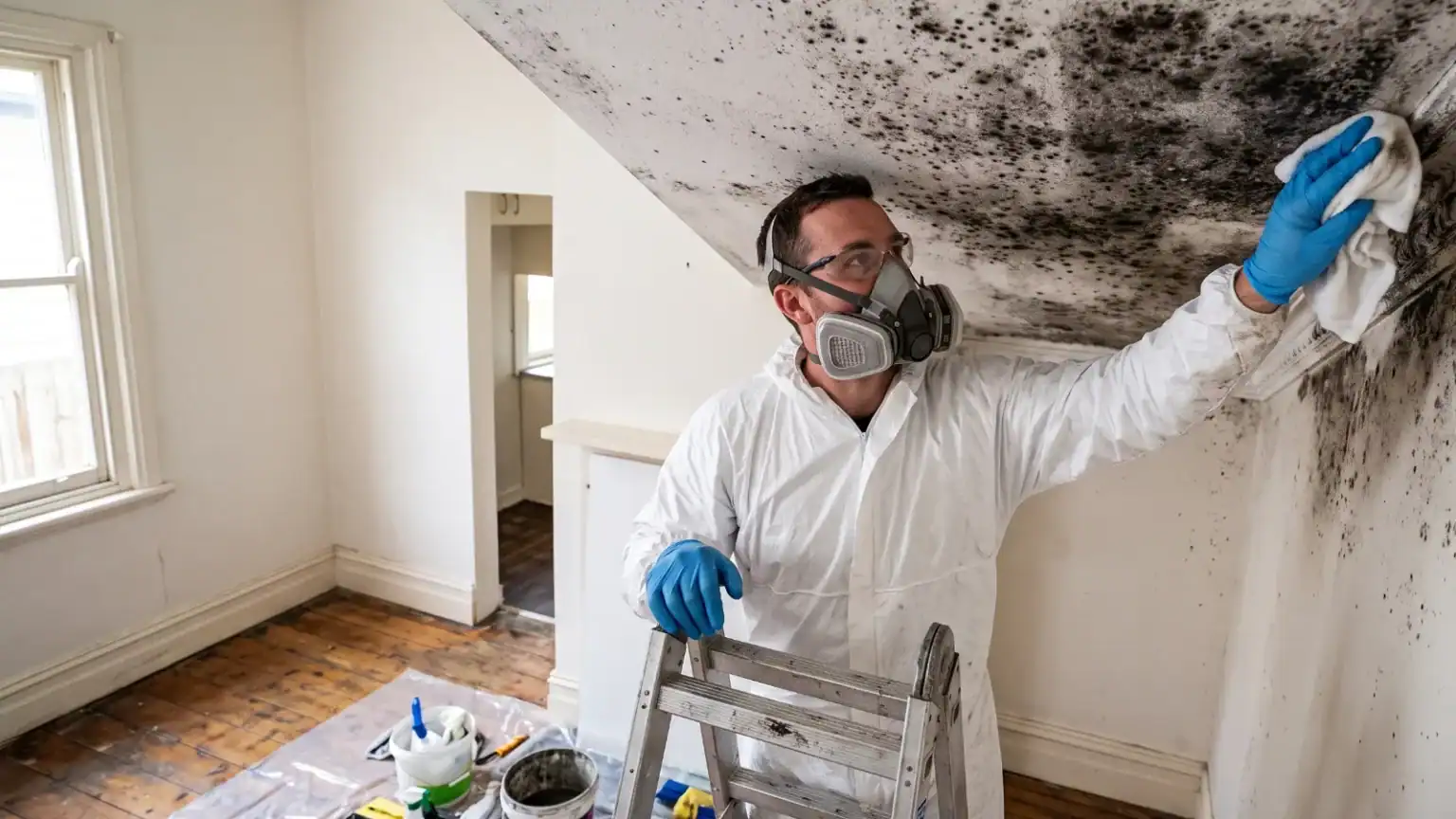
The stain is only the outer edge of a colony rooted into the ceiling material below the paint line. Lasting bathroom ceiling mould treatment means treating that root system, not just what you can see.
Need help with ceiling mould? Mould and Hygiene Solutions provides professional mould removal across Newcastle, the Central Coast, Maitland, Lake Macquarie, Hunter Valley and Port Stephens.
What Causes Mould to Grow on Ceilings
Ceiling mould forms when moisture, warmth, and organic material all land on the same surface at once. Plasterboard ceilings are the primary target in Australian homes because the gypsum core absorbs moisture from condensation and minor leaks, the paint layer provides organic binder that mould feeds on, and warm air rising against the ceiling keeps the colony at its preferred temperature.
Unlike mould on tiles or glass, mould on plasterboard roots into the porous substrate within days of settling. Surface cleaning removes the visible stain but leaves the hyphae (root structure) alive inside the ceiling material.
The most common moisture sources behind ceiling mould growth include:
- Bathroom and kitchen condensation from hot showers and cooking without adequate exhaust ventilation
- Exhaust fans venting into the roof cavity instead of through the roof or eave to outside
- Roof leaks from cracked tiles, degraded flashing, or blocked gutters allowing water to pool above
- Missing or compressed ceiling insulation creating a cold surface that attracts condensation from the room below
- Indoor clothes drying without opening windows or running a dehumidifier
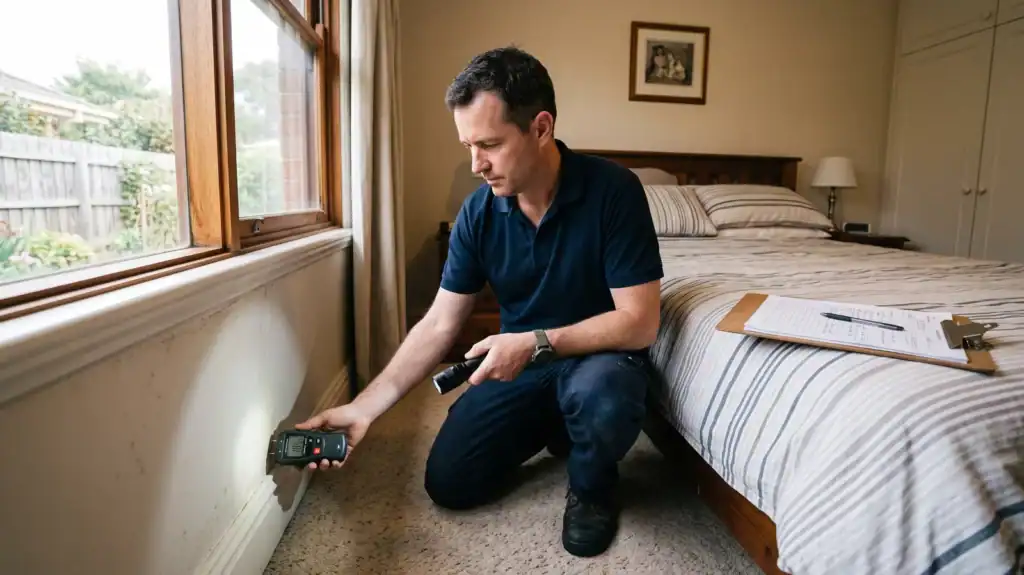
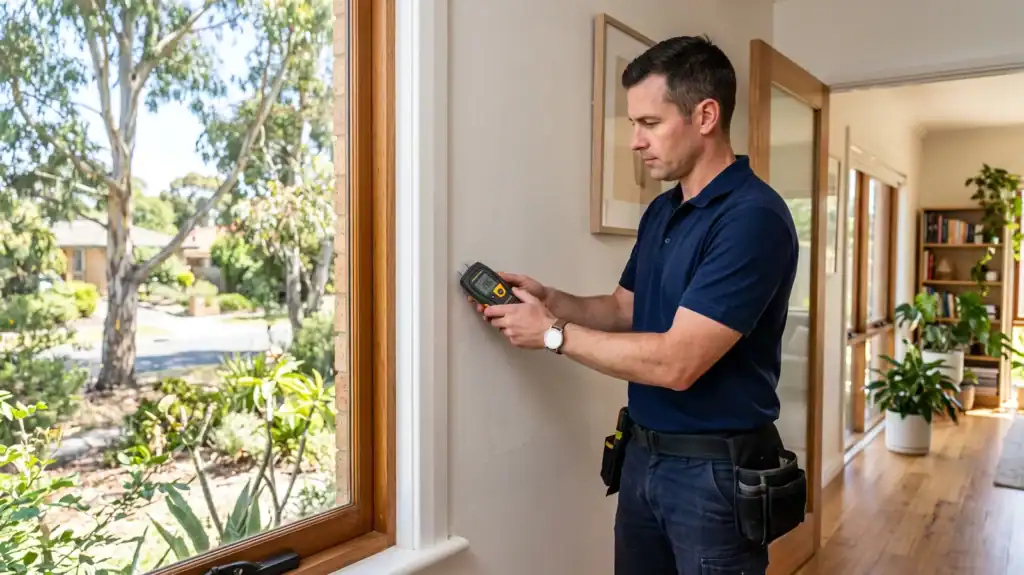
A professional mould inspection identifies these hidden moisture sources before the colony spreads further into the ceiling structure.
NSW Health recommends keeping indoor humidity below 60% to limit mould growth. A basic hygrometer from any hardware store tells you exactly where your home sits.
Why Bathroom Ceilings Are the Most Common Target
Bathrooms produce more airborne moisture per square metre than any other room in the house. A single hot shower generates between 0.5 and 1.5 litres of water vapour in under ten minutes, and that moisture rises straight to the ceiling.
Several factors make bathroom ceilings more vulnerable than other rooms:
- Repeated steam cycles a family of four running two showers a day pushes warm, wet air against the same ceiling surface multiple times every 24 hours
- Small, enclosed spaces most Australian bathrooms are compact rooms with one small window or none at all, trapping humid air against the ceiling
- Exhaust fans undersized or poorly ducted many older homes across the Hunter Valley and Lake Macquarie have bathroom fans that vent into the roof cavity instead of outside, dumping moisture directly above the plasterboard
- No insulation above the bathroom when the ceiling plasterboard sits directly below an uninsulated roof space, warm shower steam hits a cold surface and condenses immediately
The result is a ceiling that never fully dries between showers. Mould spores land, germinate, and push hyphae into the plasterboard within 48 to 72 hours of sustained dampness.
Shower steam is not the only culprit. Leaking shower recesses, dripping taps left unrepaired, and bath overflow pipes that weep behind the wall all add hidden moisture to the ceiling cavity above. If you notice mould spreading through your shower area as well as the ceiling, the moisture source may be structural rather than just condensation.
Is It a Roof Leak or Condensation?
The first step in bathroom ceiling mould treatment is working out where the moisture originates. Treating condensation when you actually have a roof leak (or the reverse) wastes time and money, and the mould comes back regardless.
| Sign | Roof leak | Condensation |
|---|---|---|
| Pattern | Localised, often near joins or edges | Spread across flat ceiling areas |
| Timing | Appears or worsens after rain | Worse in winter or after hot showers |
| Staining | Yellow or brown water marks | Grey or black mould clusters |
| Touch test | Ceiling feels damp or soft to touch | Surface dry between episodes |
| Roof cavity | Visible water trail on rafters | No water trail, but insulation feels clammy |
Mould on your ceiling after rain will not fix itself. Addressing the leak above is the first step before any mould treatment will hold.
If you cannot tell which one you are dealing with, professional mould testing pinpoints the exact moisture source so the right fix is applied the first time.
Why DIY Bathroom Ceiling Mould Removal Does Not Last
Every retail mould product sold in Australia works the same way: it kills or bleaches mould on the surface you can see. The colony growing inside the plasterboard beneath the paint layer stays untouched, and regrowth typically starts within weeks because the hyphae embedded in the gypsum core remain alive.
Each common method falls short on plasterboard ceilings for the same reason:
- Bleach removes the dark stain but does not penetrate plasterboard. The hyphae survive and push new growth through the same spot within weeks.
- White vinegar kills some surface mould species on non-porous tiles, but on a porous ceiling it sits on the paint and evaporates before reaching the colony underneath.
- Bicarb paste works as a mild abrasive that scrubs away surface growth. It has zero antimicrobial action at depth.
- Hardware store mould killer sprays contain the same active ingredients as diluted bleach. Same limitation, different packaging.
DIY removal also ignores the moisture source feeding the colony. In a bathroom, that source reloads every time someone takes a shower. Without fixing the ventilation or the leak behind the wall, no surface treatment will hold.
Disturbing a mould colony without proper containment sends thousands of spores airborne through the rest of the home. This is one of the key reasons why ceiling mould keeps returning after a DIY clean.
The cost adds up: Products, repainting, and time spent on three or four rounds of DIY per year often exceeds what a single professional mould remediation treatment costs. None of those DIY rounds fix the moisture source underneath. When you compare what professional mould removal actually costs in Australia, the one-time investment is almost always less than a year of repeating the same clean.
Bathroom Exhaust Fans and Ventilation
Poor ventilation is behind most bathroom ceiling mould. The exhaust fan is the single most important piece of equipment in preventing regrowth after treatment, and in most problem bathrooms it is either undersized, poorly ducted, or both.
Common exhaust fan problems that lead to bathroom ceiling mould:
- Ducting into the roof cavity the fan removes steam from the bathroom and dumps it directly above the ceiling plasterboard, where it condenses and feeds the colony from the other side
- Fan too small for the room a standard 150 mm bathroom fan moves roughly 150 to 200 cubic metres per hour, which is not enough for larger bathrooms or ensuites with separate shower and bath areas
- Fan switched off too early steam continues to rise for 10 to 15 minutes after the shower stops, and a fan that turns off with the light leaves the ceiling wet during that window
- Blocked or crushed ductwork flexible duct runs sag under insulation over time, creating low points where condensation pools and airflow drops
The fix is straightforward: the fan must duct to the outside of the building (through the roof or soffit), it must be rated for the room volume, and it must run for at least 15 to 20 minutes after the last shower.
Condensation in winter is worse. Properties across Newcastle and the Central Coast see a spike in bathroom ceiling mould during the cooler months when warm shower steam meets a cold ceiling. Understanding why winter condensation causes mould in your home helps explain why ventilation alone may not be enough without proper ceiling insulation above the bathroom.
What Professional Bathroom Ceiling Mould Treatment Involves
Professional ceiling mould removal treats the substrate below the paint line, contains spores during the process, and identifies the moisture source driving the growth. Skip any one of those steps and the mould comes back.
A treatment from Mould and Hygiene Solutions includes:
- Containment setup to isolate the affected area and prevent spore spread through the rest of the property
- Substrate-level treatment using an Australian-made, non-hazardous, non-corrosive and environmentally friendly antimicrobial solution that penetrates plasterboard to kill hyphae below the surface
- Moisture source identification so the underlying cause of growth is addressed, not just the visible symptom
- Written inspection report documenting affected areas, treatment applied, and preventive recommendations for the property owner
Every treatment is backed by a 12-month mould-free guarantee. If mould returns in the treated area within 12 months, the retreatment is covered at no additional cost.
For bathrooms specifically, the inspection also assesses exhaust fan ducting, shower recess waterproofing, and ceiling insulation above the wet area. These are the three structural factors that determine whether bathroom ceiling mould will return after treatment.
How to Stop Bathroom Ceiling Mould From Returning
Getting rid of the mould once is the easy part. Stopping it from growing back means cutting off the moisture supply that feeds it.
- Run bathroom exhaust fans during and after every shower or bath for at least 15 to 20 minutes, or until mirror fog and wall condensation have cleared
- Open windows in bathrooms and kitchens when weather allows to let damp air escape
- Use a dehumidifier in rooms that consistently read above 60% humidity
- Check ceiling insulation and upgrade if batts have compressed or shifted over time
- Clear gutters and downpipes at least twice a year to prevent water pooling above the ceiling line
- Avoid drying clothes on indoor racks without active ventilation running
- Wipe down shower walls and the ceiling directly above the shower after each use to remove standing water
Fibro and weatherboard homes across the Hunter Valley and Lake Macquarie often have no ceiling insulation at all, which means condensation forms every winter morning when warm indoor air hits the cold plasterboard above. Ongoing mould prevention measures reduce the chance of regrowth after professional treatment.
Frequently Asked Questions
What kills mould permanently on a bathroom ceiling?
Surface treatments like bleach and vinegar cannot reach the hyphae embedded inside plasterboard, so the mould grows right back. A professional-grade antimicrobial solution applied to the substrate kills the colony at its roots and, combined with fixing the moisture source, produces a lasting result.
Does bleach actually kill ceiling mould?
Bleach removes the dark stain on the surface but does not penetrate porous plasterboard. The hyphae survive underneath and regrow within weeks. Understanding what actually kills mould on different surfaces shows why no retail product treats the root system in a ceiling.
How do I get rid of black mould on my bathroom ceiling?
Identify whether the moisture comes from a roof leak, condensation, or a leaking shower recess first (the comparison table above covers the signs). Black mould on a plasterboard ceiling has already rooted into the substrate, so professional treatment with an antimicrobial solution that penetrates the material is the only lasting fix.
Does ceiling mould go away on its own?
No. Drying out the area may make the visible stain fade, but the colony enters a dormant state and reactivates as soon as moisture returns. The hyphae remain alive inside the ceiling material even when the surface looks clean.
Is black mould on the ceiling dangerous?
Not all dark ceiling mould is Stachybotrys (the species commonly called “toxic black mould”). However, black mould poses real health risks. Any mould growth can irritate airways and trigger allergic reactions in sensitive people, and Healthdirect Australia recommends removing mould promptly regardless of the species.
Can I paint over ceiling mould?
Painting over mould traps the colony under a fresh layer. The mould continues growing through the new paint because it now has additional organic binder to feed on, and painting over mould never works no matter how many coats go on.
Why does bathroom ceiling mould keep coming back after cleaning?
Two reasons work together. First, retail products only treat the surface, leaving hyphae alive in the plasterboard. Second, the moisture source (usually shower steam plus poor ventilation) reloads every day. Until both the colony and the moisture source are dealt with, the mould returns on the same cycle.
What do professionals use to remove ceiling mould?
Professional mould removers use industrial-grade antimicrobial solutions that penetrate porous surfaces like plasterboard to kill mould at the root level. The treatment includes physical containment to prevent spore spread and a moisture assessment to identify and fix the underlying cause.
How big does ceiling mould need to be before calling a professional?
NSW Health recommends professional intervention for mould covering more than one square metre. Any mould on a plasterboard ceiling that has returned after a DIY clean also warrants professional assessment, regardless of size, because the root system has already established itself in the substrate.
Does the property owner or tenant pay for ceiling mould removal?
Under the NSW Residential Tenancies Act 2010 (s 63), property owners must maintain the property in a reasonable state of repair, and that includes addressing mould caused by structural issues like leaks or inadequate ventilation. A professional inspection report gives both the property owner and tenant clear documentation of the cause and the recommended fix.
Should I use mould-resistant paint on my bathroom ceiling?
Mould-resistant paint contains additives that slow surface mould growth, but it does not stop a colony already rooted in the plasterboard. It works as a preventive layer on a ceiling that has been professionally treated and dried, not as a treatment for existing mould. Apply it after the mould and moisture source have been dealt with, not before.
How long does bathroom ceiling mould take to grow back after cleaning?
After a surface clean with bleach or a retail spray, regrowth typically appears within two to six weeks. The timeline depends on how often the bathroom is used and how effectively moisture is vented out. In bathrooms with poor exhaust ventilation, visible regrowth can appear in as little as a fortnight.
Bathroom ceiling mould that keeps coming back is a moisture problem, not a cleaning problem. Until the source is identified and the colony is treated below the surface, no amount of scrubbing produces a lasting fix.
Mould and Hygiene Solutions provides professional ceiling mould removal across Newcastle, the Central Coast, Maitland and the Hunter Valley, backed by a 12-month mould-free guarantee. Book a mould inspection to find out where the moisture is coming from and what it takes to fix it properly.