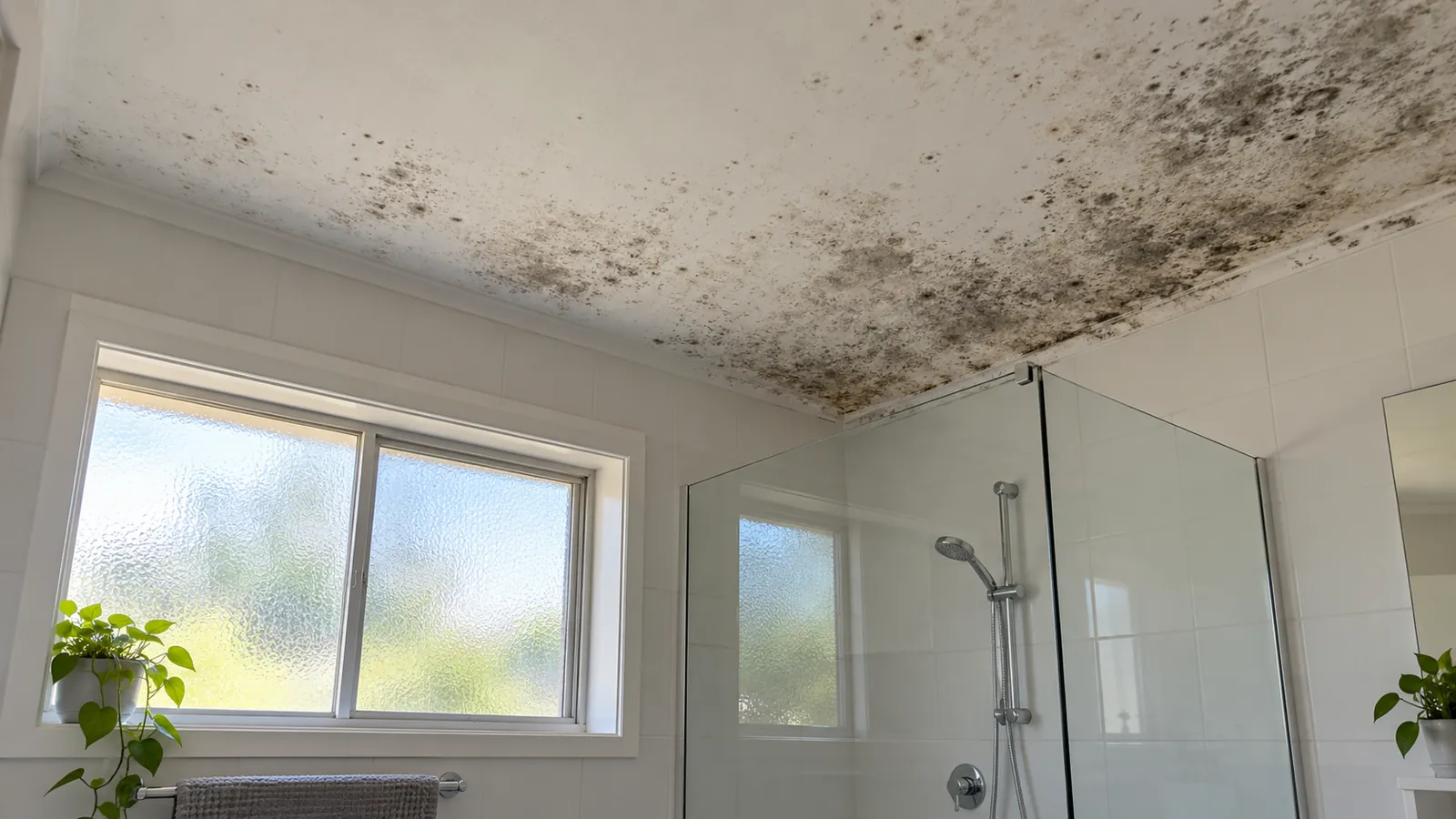
Surface cleaning removes what you can see, but mould on your ceiling has already grown into the material beneath.
Most homeowners across Newcastle and the Central Coast reach for bleach or vinegar the moment they spot dark patches overhead. The problem is that ceiling mould is rarely just a surface stain. By the time discolouration appears, the colony has already pushed roots (called hyphae) into the plasterboard or paint layer underneath.
Below you will find safe cleaning steps for minor patches, an honest look at why those steps stop working, and what actually fixes the problem when surface cleaning is not enough.
Already tried cleaning and the mould keeps returning? That pattern points to a moisture source or substrate contamination that surface cleaning cannot fix. Read why mould keeps coming back on your ceiling or book a professional mould inspection to find the root cause.
Why Mould Grows on Ceilings
Ceilings are one of the first surfaces in a home to develop mould. Warm, humid air rises and meets the cooler ceiling surface, forming condensation. That thin moisture layer is all mould spores need to colonise.
A few things make ceilings worse than walls for mould:
- Poor ventilation in bathrooms, laundries and bedrooms traps humid air against the ceiling for hours
- Roof leaks saturate plasterboard from above, feeding mould growth you cannot see from the room
- Lack of exhaust fans means steam from showers and cooking has nowhere to go
- Indoor humidity above 60% creates conditions where mould can germinate on almost any surface
The cause determines whether cleaning the ceiling will hold. Condensation mould from a steamy bathroom might stay away if you fix the ventilation. Mould fed by a roof leak returns within weeks regardless of what you spray on it.
Ceiling mould that appeared after heavy rain is a different problem entirely. Water is entering from above and saturating the plasterboard. Read what to do when mould appears on your ceiling after rain.
Safety Gear You Need Before Cleaning Mould off a Ceiling
Disturbing mould releases spores into the air. Without proper protection, you breathe them in while scrubbing directly underneath the affected area. Better Health Victoria recommends wearing protective equipment when handling any mould cleanup.
Gather this equipment before you start:
- P2 or N95 respirator mask (a dust mask or surgical mask is not sufficient)
- Safety goggles that seal around your eyes (spore-laden drips fall directly downward)
- Rubber gloves that extend past your wrists
- Old clothes you can wash on a hot cycle or discard afterward
- Drop sheets on the floor beneath the work area to catch debris
- A stable step ladder (never stand on chairs or furniture to reach a ceiling)
Open windows and turn on exhaust fans before you begin. Cross-ventilation helps carry loose spores outside rather than settling them on other surfaces in the room.
How to Clean Surface Mould from Your Ceiling
For patches of surface mould under roughly one square metre, cleaning can remove the visible growth. Larger areas or mould that has stained through the paint indicate deeper contamination that surface cleaning will not resolve.
Follow these steps:
- Mix your cleaning solution. White vinegar undiluted in a spray bottle is the most effective household option. Vinegar is mildly acidic and can kill many common mould species on the surface.
- Spray the affected area generously. Do not drench the ceiling to the point of dripping, as excess moisture can damage plasterboard and worsen the problem.
- Let it dwell for 15 to 20 minutes. The solution needs time to break down the mould colony on the surface.
- Wipe with a microfibre cloth or soft sponge. Work gently in one direction. Scrubbing hard damages the paint and pushes spores deeper into the surface.
- Rinse with clean water using a separate cloth, then dry the area thoroughly with a clean towel.
- Dispose of all cloths in a sealed bag. Do not reuse them elsewhere in the house.
Vinegar, bleach and commercial sprays only act on the mould growing on the surface. Mould hyphae embedded in plasterboard sit below the paint layer where no spray can reach them. Cleaned patches often show new growth within two to six weeks.
Comparing Common DIY Cleaning Methods
| Method | Kills surface mould | Reaches mould roots | Safe on painted ceilings | Lasting result |
|---|---|---|---|---|
| White vinegar (undiluted) | Yes | No | Yes | Temporary (2-6 weeks) |
| Bleach solution (1:10) | Whitens only | No | Can damage paint | Temporary |
| Commercial mould spray | Yes | No | Check label | Temporary |
| Sugar soap | Removes staining | No | Yes | Cosmetic only |
| Professional antimicrobial treatment | Yes | Yes (penetrates substrate) | Yes | 12-month guarantee |
Bleach is the most commonly recommended solution online, yet bleach does not kill mould at the root level. It bleaches the surface discolouration white, giving the appearance of removal while the colony beneath remains active. The mould returns looking exactly the same within weeks.
Why Cleaning Mould off Your Ceiling Fails Long-Term
Every retail product at a hardware store works on the same principle: kill or remove what is visible on the surface. None of them penetrate plasterboard, timber or textured paint where mould roots establish themselves.
Surface cleaning fails for predictable reasons:
- Mould roots survive beneath the surface. Hyphae grow into porous ceiling materials within days of the colony establishing. Wiping the surface removes the visible fruiting body but leaves the root network intact. Regrowth begins almost immediately.
- Scrubbing without containment spreads spores. Disturbing a mould colony on a ceiling sends spores falling onto every surface below. Without proper containment barriers, you can spread the contamination to rooms that were previously clean.
- The moisture source is never addressed. Mould does not grow without moisture. Cleaning the ceiling without identifying and fixing the moisture source (condensation, a roof leak, poor ventilation) guarantees the mould will return to the same spot.
This is why homeowners across Lake Macquarie and the Hunter Valley often find themselves cleaning the same ceiling patch every few months. The visible mould is a symptom. The actual problem is moisture reaching the ceiling substrate and a colony that has already established below the paint.
When Ceiling Mould Needs Professional Treatment
DIY cleaning has a narrow window where it makes sense: a small patch of fresh surface mould on a non-porous surface in a room where you have already fixed the ventilation. Outside that window, professional treatment is the only approach that lasts.
Call a professional mould removal specialist when:
- The affected area is larger than roughly one square metre
- Mould has returned after you have already cleaned it
- You can see dark staining through the paint (mould has penetrated the substrate)
- The ceiling shows signs of water damage, bubbling or sagging
- You suspect mould may have spread into the roof cavity above
- Anyone in the household has unexplained respiratory symptoms or allergic reactions (mould exposure can trigger nasal irritation, eye irritation and wheezing according to NSW Health)
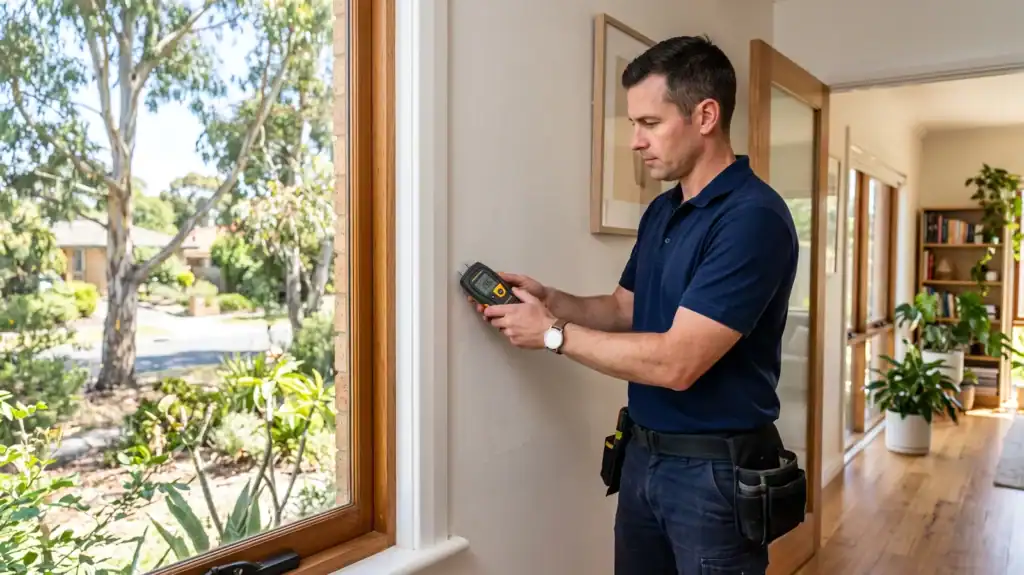
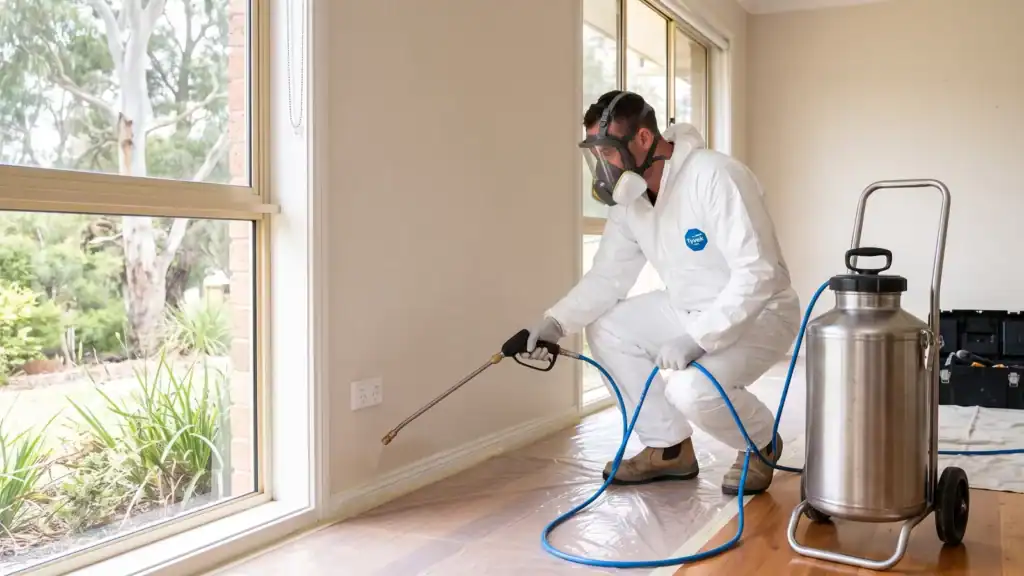
Professional treatment differs from DIY in three fundamental ways. Industrial-grade antimicrobial solutions penetrate the ceiling substrate to kill mould at the root, not just the surface. Mould and Hygiene Solutions uses an Australian-made, non-hazardous, non-corrosive and environmentally friendly antimicrobial solution that treats the entire contaminated area.
Containment barriers prevent spore spread during treatment. A thorough moisture assessment identifies the source feeding the colony so it does not return.
Mould and Hygiene Solutions backs every treatment with an unconditional 12-month mould-free guarantee. If the mould returns within 12 months, the treatment is repeated at no cost.
How to Reduce Ceiling Mould Risk After Cleaning
Whether you cleaned the ceiling yourself or had it professionally treated, these habits reduce the chance of mould returning:
- Run exhaust fans during and for 20 minutes after every shower, bath or cooking session
- Keep indoor humidity below 60%. A basic hygrometer shows you the reading. Read more about what humidity level actually prevents mould
- Improve airflow by opening windows when weather permits, particularly in bedrooms overnight
- Use a dehumidifier in enclosed rooms with consistently high moisture (laundries, bathrooms without windows)
- Check your roof space annually for leaks, blocked vents or missing insulation
- Wipe down bathroom ceilings with a dry cloth after steamy showers to remove condensation before it settles
Prevention works best when the existing mould has been fully eliminated, including the root structure. If you have only cleaned the surface, the colony beneath continues growing regardless of ventilation. Proper ventilation prevents new mould from forming but cannot stop an existing colony.
Frequently Asked Questions
Can you just paint over mould on the ceiling?
Painting over mould does not kill it. The colony continues growing beneath the new paint layer and will push through within weeks.
The surface must be fully treated and the mould eliminated before any repainting. Read why painting over mould never works for the full explanation.
Does black mould on the ceiling mean the roof space is contaminated?
Not always, but it is a strong warning sign. Black mould (often Stachybotrys or Aspergillus species) on a ceiling can indicate moisture entering from above, which means the roof cavity may also be affected. A professional mould inspection includes checking above the ceiling line to assess the full extent of contamination.
Is it safe to clean mould off the ceiling yourself?
For small patches of surface mould (under one square metre), cleaning with proper PPE is possible. Wear a P2 respirator, goggles and gloves.
Even a small patch that returns after cleaning indicates a deeper problem. Larger areas, recurring mould, or any situation involving dark-coloured mould colonies should be assessed by a professional with containment equipment.
Why does mould keep coming back on my ceiling after I clean it?
Recurring ceiling mould means one of two things: the moisture source has not been addressed, or the mould roots have survived beneath the surface. Retail cleaning products only treat the visible layer. The hyphae embedded in the plasterboard continue growing and produce new surface colonies within weeks.
Does vinegar or bleach work better for cleaning mould off ceilings?
Vinegar is more effective than bleach at killing surface mould. Bleach primarily whitens the discolouration without killing the organism, and its water content can add moisture to porous surfaces.
Neither product reaches mould roots embedded in plasterboard. For a temporary surface clean, undiluted white vinegar is the better choice.
If mould on your ceiling keeps returning or covers an area larger than you are comfortable handling yourself, the most effective step is a professional mould inspection. Mould and Hygiene Solutions provides inspections and treatments across Newcastle, the Central Coast, Lake Macquarie, Hunter Valley and Port Stephens. Visit the Mould and Hygiene Solutions website to book a professional mould inspection.