Newcastle’s climate makes mould almost unavoidable without the right approach.
The combination of coastal humidity, year-round rainfall, and older housing stock means Newcastle properties face mould pressure that most inland cities simply don’t. Many homeowners across Newcastle and the Central Coast attempt DIY mould removal first.
The problem is that by the time mould is visible on a surface, the colony has already established itself in the material beneath. The same conditions affect homes right along the coast, which is why Central Coast homes are just as prone to mould as those in Newcastle.
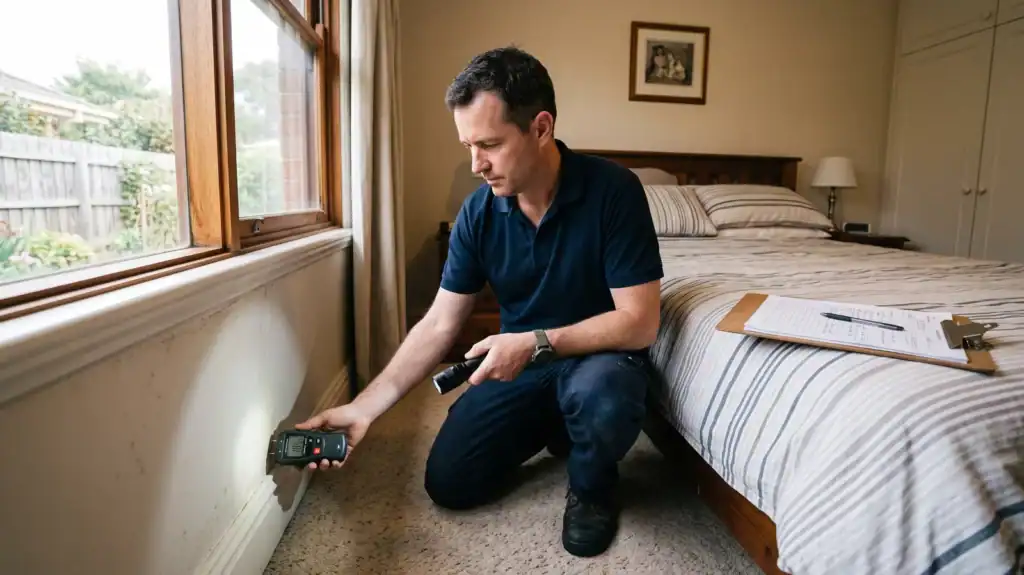
If you have found mould in your Newcastle home, the most effective first step is a professional inspection. Mould and Hygiene Solutions offers inspections across Newcastle, the Central Coast, Lake Macquarie, Hunter Valley and Port Stephens.
Three Climate Factors That Make Mould Thrive in Newcastle
Newcastle sits in a humid subtropical climate zone. According to Bureau of Meteorology records for Newcastle, the city receives 1,017mm of rainfall per year and averages around 70% relative humidity year-round.
Mould begins growing when indoor humidity stays above 60% for an extended period, a threshold established by the WHO guidelines on indoor air quality. In Newcastle, outdoor humidity rarely drops below 64% even in the driest month (September).
That means the conditions for mould growth exist every single day of the year.
- Coastal humidity: prevailing sea breezes push moisture-laden air directly into homes along the coastline and inland suburbs
- Year-round rainfall: 1,017mm spread across all twelve months, with no extended dry period to let homes dry out
- East Coast Low storms: these intense weather systems can dump over 100mm of rain in a single day, flooding subfloors and saturating walls
The January 2016 East Coast Low dropped 246mm of rain on Newcastle in 24 hours. Events like that drive moisture deep into building materials where it lingers for weeks, which is exactly how mould takes hold on ceilings and walls after heavy rain.
Newcastle’s Geography Creates a Double Moisture Problem
Newcastle is squeezed between the Pacific Ocean to the east and the Hunter River estuary to the west. Moisture arrives from both directions at once.
Sea breezes carry salt-laden humidity from the coast, while the river system adds ground-level moisture from the west. Suburbs closest to both water bodies are hit hardest.
Stockton cops salt air on three sides. Hamilton and Islington sit on clay soils near the river floodplain, trapping ground moisture beneath homes.
| Risk Factor | Most Affected Suburbs |
|---|---|
| Coastal salt air | Stockton, Newcastle East, Merewether, Bar Beach |
| River/estuary moisture | Hamilton, Islington, Tighes Hill, Carrington |
| Clay soil + poor drainage | Wallsend, Jesmond, Lambton, New Lambton |
| Valley funnelling | Charlestown, Kotara, Adamstown |
The clay-heavy soils in Newcastle’s western suburbs are a particular problem. Clay holds water rather than draining it, which means the ground beneath a house stays damp long after rain has stopped.
That persistent ground moisture feeds rising damp through subfloors and into walls.
Older Housing Stock That Traps Moisture
Newcastle’s building history is part of the problem. A significant proportion of homes in suburbs like Hamilton, Adamstown, and Merewether were built between 1885 and 1960.
These older buildings were designed for a different era and many of their original features now work against them.
- Federation weatherboard (1885-1920): single-skin timber walls with no insulation or vapour barrier, original subfloor vents often blocked or degraded
- Mid-century brick veneer (1950s-1970s): cavity walls that trap condensation, minimal roof ventilation, single-glazed windows
- Modern sealed apartments (2000s+): energy-efficient but often over-sealed with insufficient mechanical ventilation, trapping cooking and shower moisture inside
Federation homes lose their subfloor ventilation over time. Mid-century homes trap condensation in wall cavities.
Modern apartments seal moisture in with nowhere for it to go. Each era has its own mould vulnerability.
Single-glazed windows are one of the most common mould triggers in older Newcastle homes. Cold glass creates a condensation point where warm indoor air meets the cool surface, and that moisture runs into the window frame and the wall below.
Where Mould Hides in Newcastle Homes
Visible mould on a bathroom ceiling or bedroom wall is usually the last stage, not the first. By the time you can see it, the colony has been growing in the substrate beneath for weeks or months.
- Bathrooms: ceiling, grout lines, silicone seals, behind tiles where waterproofing has failed
- Bedrooms: corners of external walls, behind wardrobes pushed against cold walls, mattress undersides
- Subfloors: timber bearers and joists in raised homes, especially where vents are blocked or ground drainage is poor
- Ceiling cavities: above bathrooms and kitchens where steam rises and condenses on the underside of the roof
- Window frames and sills: condensation runoff on single-glazed windows feeds mould in timber frames and plaster beneath
- Wardrobes and cupboards: enclosed spaces with no airflow against external walls
Subfloor mould is especially common in Newcastle’s older raised homes. When the original terracotta vents become blocked by soil, plants, or debris, airflow under the house stops entirely.
The trapped moisture turns the subfloor into a breeding ground.
Why DIY Mould Removal Does Not Work in Newcastle
Spraying bleach or vinegar on visible mould removes the surface discolouration. The mould root structure (hyphae) embedded in the plaster, timber, or grout beneath is completely unaffected.
Regrowth typically occurs within two to six weeks. DIY mould removal fails for three specific reasons.
- Retail products only treat the surface. Bleach, vinegar, tea tree oil, and supermarket mould sprays do not penetrate porous building materials. The mould roots survive and regrow. Even products marketed as stronger alternatives, like methylated spirits, do not reach the hyphae embedded in the substrate.
- The moisture source is never addressed. Mould grows because there is excess moisture. Wiping the mould off a wall does nothing about the leaking pipe, blocked vent, or condensation issue causing it.
- Disturbing mould without containment spreads spores. Scrubbing a mouldy surface releases millions of spores into the air, which settle in other rooms and start new colonies.
In Newcastle’s humidity, the regrowth cycle is faster than in drier climates. A cleaned bathroom ceiling can show new mould within a fortnight during summer.
No Off-Season for Mould in Newcastle
In most parts of Australia, mould is mainly a summer problem. Newcastle does not get that reprieve.
- Summer (December to February): humidity peaks at 74 to 75%, feeding mould growth directly through warm, damp air
- Winter (June to August): outdoor humidity drops slightly, but cold single-glazed windows create heavy condensation indoors, feeding mould from the inside
- Shoulder seasons: east coast lows and sustained rainfall saturate building materials, especially subfloors and wall cavities
Newcastle homes face year-round mould pressure from different moisture sources depending on the season. Professional mould prevention addresses all three pathways, not just whichever one is obvious at the time.
What Professional Mould Treatment Actually Does
Professional mould removal addresses the three things DIY cannot: the moisture source, the embedded root structure, and the airborne spore load.
Mould and Hygiene Solutions uses an Australian-made, non-hazardous, non-corrosive and environmentally friendly antimicrobial solution that penetrates the substrate to kill mould at the root. Unlike a surface spray, it reaches the hyphae buried inside the material.
- Moisture source identification: finding and fixing the leak, ventilation failure, or condensation issue that caused the mould in the first place
- Containment: isolating the treatment area to prevent spore spread during removal
- Antimicrobial treatment: applying the solution to kill mould roots within the substrate, not just the visible surface
- Post-treatment verification: confirming the treatment has been effective and the moisture issue is resolved
Every job comes with a 12-month mould-free guarantee. If mould returns within twelve months of treatment, Mould and Hygiene Solutions comes back and re-treats at no additional cost.
That guarantee only works because the treatment addresses the root cause, not just the symptom.
Preventing Mould in a Newcastle Home
You cannot change Newcastle’s climate, but you can reduce the moisture that feeds mould inside your home.
- Run exhaust fans during and for at least 15 minutes after every shower or bath
- Open windows on opposite sides of the house when weather allows to create cross-ventilation
- Keep furniture at least 50mm away from external walls to allow airflow
- Use a dehumidifier in rooms that consistently feel damp, especially in winter
- Check subfloor vents are clear of soil, plants, and debris at least twice a year
- Fix leaking taps, pipes, and roof flashings as soon as they appear
- Dry clothes outdoors or in a well-ventilated laundry with the door closed and exhaust fan running
Prevention reduces the chance of mould, but in Newcastle’s climate it does not eliminate it entirely. If mould keeps returning despite good ventilation habits, the moisture source is likely structural and needs professional assessment.
Mould and Hygiene Solutions offers professional mould inspections across Newcastle, the Central Coast, Lake Macquarie, Hunter Valley and Port Stephens. A professional inspection identifies the moisture source driving the mould and provides a written report with treatment recommendations.
Frequently Asked Questions
Why is mould so common in Newcastle?
Newcastle sits in a humid subtropical climate with 1,017mm of annual rainfall and average humidity around 70% year-round. The combination of coastal moisture, the Hunter River estuary, and a large stock of older homes with poor ventilation creates conditions where mould can grow in any month of the year.
Can I remove mould myself with bleach?
Bleach removes the visible discolouration but does not kill the mould root structure embedded in the material beneath. Regrowth typically appears within two to six weeks.
Professional treatment uses an antimicrobial solution that penetrates the substrate to kill mould at the root.
Which Newcastle suburbs have the worst mould problems?
Suburbs near the coast (Stockton, Newcastle East, Merewether) face salt-air moisture. Suburbs near the river on clay soils (Wallsend, Jesmond, Hamilton) deal with rising damp and poor drainage.
Older suburbs with pre-1960s housing stock (Adamstown, Islington, Lambton) are vulnerable because of degraded subfloor ventilation.
What humidity level causes mould to grow?
Mould begins growing when relative humidity stays above 60% for an extended period, combined with temperatures between 25 and 30 degrees Celsius. Newcastle’s average outdoor humidity rarely drops below 64%, which means the conditions for mould growth exist year-round.
Is mould in my home dangerous?
According to NSW Health, mould exposure can cause respiratory symptoms including a runny or blocked nose, eye and skin irritation, and wheezing. People with asthma, COPD, or weakened immune systems are at higher risk.
If you suspect mould in your home, a professional mould test can confirm the type and severity.
Does home insurance cover mould removal?
Most standard home insurance policies do not cover mould removal unless the mould resulted directly from a sudden, insured event like storm damage or a burst pipe. Gradual mould caused by poor ventilation or maintenance is typically excluded.
Check your specific policy wording or contact your insurer.
Why does mould keep coming back after I clean it?
Retail cleaning products only remove the visible mould on the surface. The root structure (hyphae) remains embedded in the plaster, timber, or grout underneath.
Without killing that root network and fixing the moisture source that feeds it, regrowth is inevitable within weeks.
Does mould grow in winter in Newcastle?
Yes. While summer humidity drives mould growth directly, winter creates a different problem. Cold single-glazed windows cause heavy condensation on the glass, which runs into frames and walls.
That trapped moisture feeds mould growth through the cooler months, making Newcastle a year-round mould environment.
Who is responsible for mould in a rental property in NSW?
Under NSW tenancy law, property owners are responsible for maintaining the premises in a reasonable state of repair. Mould caused by structural issues like poor ventilation, leaking pipes, or inadequate waterproofing is generally the property owner’s responsibility.
A professional mould remediation report can document the source and scope of the problem, which helps all parties agree on the right course of action.